

21 September 2026 10 min read
Timber look tiles: the complete guide for Australian homes
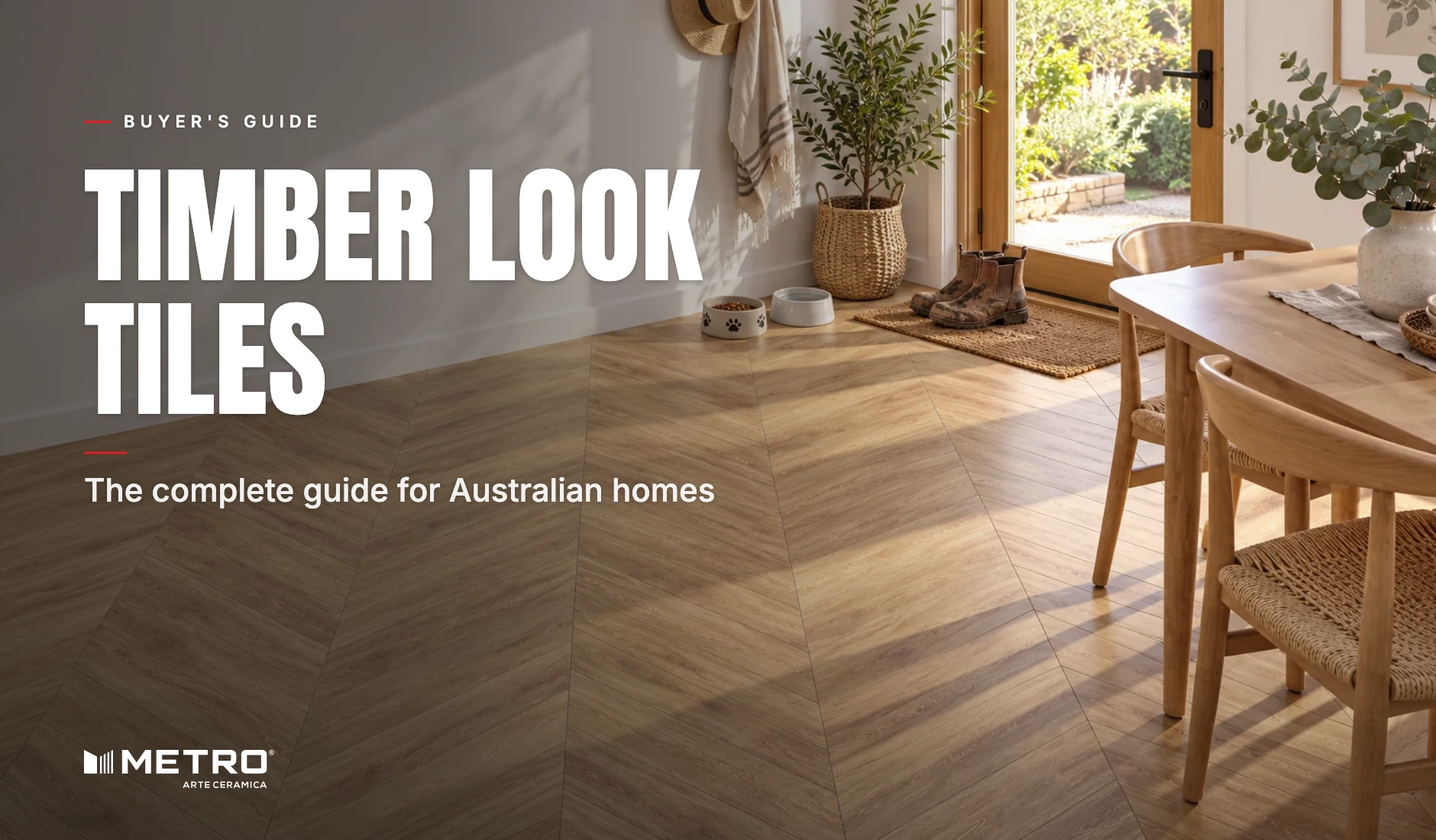
A Queensland summer does two things to a timber floor. It pushes moisture into the boards through the wet season, then sends hard afternoon light across them for the rest of the year. Northern NSW and the Top End add termites. Timber look tiles are the usual answer, and the good ones are now hard to pick from two metres away.
This guide covers what they are made of, how they behave in Australian conditions, the sizes and colours available, and what to check before ordering.
What timber look tiles actually are
A timber look tile is a ceramic tile with a timber grain printed and textured into its glazed surface. Metro's tiles are glazed ceramic, with a body that absorbs 6 to 8% water, group BIIb under EN 14411. Porcelain sits under 0.5%. That difference matters less than most sales copy suggests, because what faces your room, your mop and the weather is the glaze, not the body.
The grain comes from 3D high-definition digital printing over a moulded relief you can feel underfoot. Each design carries its own number of random faces, so neighbouring planks are not copies of each other. Across the plank range that count runs from 1 to 18. It is the best single predictor of whether a floor reads as timber or as a repeating pattern.
Planks are 9 to 9.5 mm thick, the chevron collection is 8 mm and the Diamante collection is 9 mm. Breaking strength runs 27 to 29 N/mm².
Why real timber struggles in Australian conditions
Moisture
Timber takes on water from the air and gives it back. Through a humid Queensland or NT wet season the boards swell, then shrink again in the dry. The result is cupping and gaps you can feel with a bare foot. Engineered boards move less than solid, but they still move.
UV
A north facing living room gets punishing light all summer. Stains fade unevenly, coatings chalk, and a rug left in one spot for two years leaves its shape behind.
Termites
In northern NSW, Queensland and the Top End this is a real cost, not a theoretical one. Resistant timbers hold up better, but none is immune if there is moisture and a path in.
Upkeep
Resanding, recoating, and careful cleaning near wet doorways. None of this shows up in the first year, which is why a floor chosen off a display board can disappoint by year three.
How timber look tiles handle the same conditions
Humidity does nothing to them
The tile does not take on moisture from the air, so nothing cups or gaps through a wet season. A floor in Cairns behaves the same in February as in August.
The colour is in the glaze
The grain is printed under a fired glaze, not stained into an open surface, so a north facing room is not the problem it is for timber.
Termites have nothing to eat
Ceramic is not a food source and not a nesting material.
No sealing, no resanding
A broom and a damp mop is the whole routine. There is nothing to recoat and no cycle to plan for.
They work outside as well as in
Every Metro tile can be used on outdoor floors: covered and open alfresco areas, verandahs, pergolas, patios and pool surrounds. Use the Matt Texture surface outdoors for grip. Cold regions in Victoria, Tasmania and the ACT are fine too.
Where real timber still wins
Timber is warmer underfoot and has give, which matters in a bedroom and matters more in a Tasmanian winter. Tile takes the temperature of the room, so in a cold climate it pairs best with underfloor heating. Solid timber can also be sanded back and recoated when it is tired, which no tile can do. In a period home, a real board can carry weight at resale that a tile does not.
Two other limits worth knowing. Tile and grout are water resistant, not waterproof, so a bathroom or laundry needs the substrate waterproofed first. And a hard floor is a hard floor: dropped glassware does not survive it.
The curve edge, and why it matters on a timber look tile
Most large-format tiles are pressed as a big slab, then cut down to size. That leaves a sharp square edge. A rectified tile like that suits stone and concrete looks, where a near-invisible joint is the point.
A timber board does not have a sharp square edge. Metro presses every plank to size in its own mould, so the edge comes out softly rounded, the way a sawn board is. Laid up, the joint reads as the shadow line between two boards rather than as a grout line across a slab. Metro makes only curve edge tiles, and it is the main thing separating them from a generic timber look tile.
The practical consequence for your tiler: curve edge planks want a visible joint. Use spacers of at least 3 mm, with 3 to 5 mm joints on planks. Long planks also forgive a small bow better with that joint than a hairline one would.
Sizes available
Four plank sizes, plus two collections with a shape of their own.
|
Size |
Designs |
Tiles per box |
Coverage per box |
Box weight |
|
70 |
8 |
1.08 m² |
22 kg |
|
|
56 |
5 |
1.00 m² |
20 kg |
|
|
61 |
5 |
1.20 m² |
25 kg |
|
|
20 |
4 |
1.12 m² |
24 kg |
The 150x900mm plank is the narrowest and reads closest to a sawn board. It also works on stairs, cutting to tread depth and covering a standard 900 mm tread in one piece. The 200x1000mm and 200x1200mm suit larger rooms, with fewer joints across the floor. The 200x1400mm is the longest board Metro makes, and it earns its length in open-plan living and in a hallway that runs the depth of the house.
Two collections sit outside the plank formats. The chevron collection comes as left and right pieces whose angled ends meet point to point in a V. It is made in 150x900mm and 80x450mm, 8 mm thick, with a minimum 2 mm joint. The Diamante collection is an elongated hexagon, 203x1010mm, for feature floors and wall panels.
Every plank page has a coverage calculator. Use it rather than doing the sums yourself, and add a margin for cuts and breakages.
Colours and surfaces, matched to Australian timbers
There are three surfaces. Matt Texture has low sheen and grain relief you can feel: use it in bathrooms, laundries, on staircases and on any outdoor floor. Satin Texture has a soft sheen over lighter relief, and suits living rooms and bedrooms. Satin Plain is smooth, and is mostly a wall tile.
The catalogue runs ten colour tones, palest to darkest: Natural Clear Stain, White, Golden Honey, Nutmeg, Warm Chestnut, Cinnamon, Tuscan Coffee, Merlot, Grey and Dark Grey. Golden Honey is the closest tone to blackbutt. Nutmeg and Warm Chestnut sit in spotted gum and brushbox territory. Merlot carries the depth people want from jarrah. Grey and Dark Grey read as weathered decking.
Three to look at. Madera Teak in 150x900mm is Warm Chestnut, Matt Texture, with 18 random faces, the highest count in the range. Oaklore Beige in 200x1200mm is a Golden Honey Matt Texture with 6 faces. For an alfresco or pool surround, the Ipe Out series carries a ribbed decking relief across the face, and Ipe Out Grey is the weathered grey of it. All 264 designs sit on the full design listing.
What to check before ordering
Ask any supplier these five questions, and compare the answers rather than the photos.
- Edge type. Curve edge or rectified, and if rectified, how the joint will read against a timber grain.
- Water absorption. Ask for the tested figure and the group, not an adjective. Metro's is 6 to 8%, group BIIb.
- Random face count. For that exact design, not the collection. A single-face design repeats visibly across a big room.
- Thickness. 9 to 9.5 mm on planks here.
- Certification. Metro holds CE, ISO 9001:2015 and ISO 14001, and states conformity with EN 14411.
For a wet room or an outdoor floor, also ask for the slip rating of the exact tile, tested to the Australian standard. Get it in writing rather than as a category. Full specifications for each format are in the downloadable catalogues.
Installation notes for your tiler
- Let the substrate cure at least two weeks, and check it is flat, clean and dry before anything is laid.
- Use the quarter-plank offset. Metro's laying catalogue specifies a 1/4 offset: 225 mm on 150x900mm, 250 mm on 200x1000mm, 300 mm on 200x1200mm, 350 mm on 200x1400mm. The 50:50 half offset is crossed out in that catalogue, and on a long plank it exaggerates any lippage.
- Joints of 3 to 5 mm, with spacers of at least 3 mm. Chevron and Diamante take a minimum of 2 mm.
- Follow the arrows. Every plank has an arrow printed on the back. All of them point the same way, so the grain runs consistently across the room.
- One calibre per room. Each box carries a calibre code. Do not mix calibres or batches in one floor, and open several boxes at once so shade variation spreads instead of banding.
- Grout after the bed has cured, 3 to 4 days, and clean off the excess before it hardens.
- Waterproof first in wet areas. In a shower, a plank floor works best with a linear drain and the falls set before tiling begins.
Choose by room, then by light
Work in this order: the surface for the room, then the tone for the light that room actually gets, then the size for the floor area. A north facing living room takes a paler tone better than a dark one. A bathroom or an alfresco takes Matt Texture whatever the showroom floor has on it.
Metro Wooden Tiles is India's No. 1 brand specialised in wooden tiles. We make curve edge timber look tiles in Morbi, Gujarat, and supply Australia direct from the factory. Send through the format and the area you need and you will get a rate back. Ask for samples too, and put them down in the actual room before committing. Builders and retailers ordering by the container can go through the export page, and the sustainability page sets out how the factory handles water and waste.
Still weighing it against boards? Read timber look tiles vs real timber flooring. Tiling outdoors? Read the alfresco guide.
Frequently asked questions
Are timber look tiles ceramic or porcelain?
Both exist. Metro's are glazed ceramic, with a body that absorbs 6 to 8% water. Porcelain absorbs under 0.5%. For a floor, the glaze, the surface texture and the tile's slip rating matter more.
Can timber look tiles be used outdoors in Australia?
Yes. Every Metro design can be used on outdoor floors, including covered and open alfresco areas, verandahs, patios and pool surrounds. Use the Matt Texture surface, and set the falls so water runs away rather than pooling.
Do timber look tiles fade in the sun?
No. The grain is printed under a fired glaze rather than stained into the surface. A north facing room or an open alfresco will not bleach it the way it bleaches a coated board.
What size timber look tile should I choose?
For open-plan living, 200x1200mm or 200x1400mm gives the fewest joints. For stairs, 150x900mm covers a standard 900 mm tread in one piece. For hallways and bedrooms, 200x1000mm sits in between.
Are timber look tiles cold underfoot?
In an unheated room in a cold part of Victoria or Tasmania, yes, more so than timber. They work well over underfloor heating, so plan the heating before you tile rather than after.
How do I tell a convincing timber look tile from a cheap one?
Check the random face count for that exact design, feel the surface for real grain relief, and look at the edge. A curve edge reads as the shadow line between two boards. Lay four or five samples together before you decide.