

17 August 2026 6 min read
Timber Tiles for Malaysian Homes: Built for Humidity, Heat and Monsoon
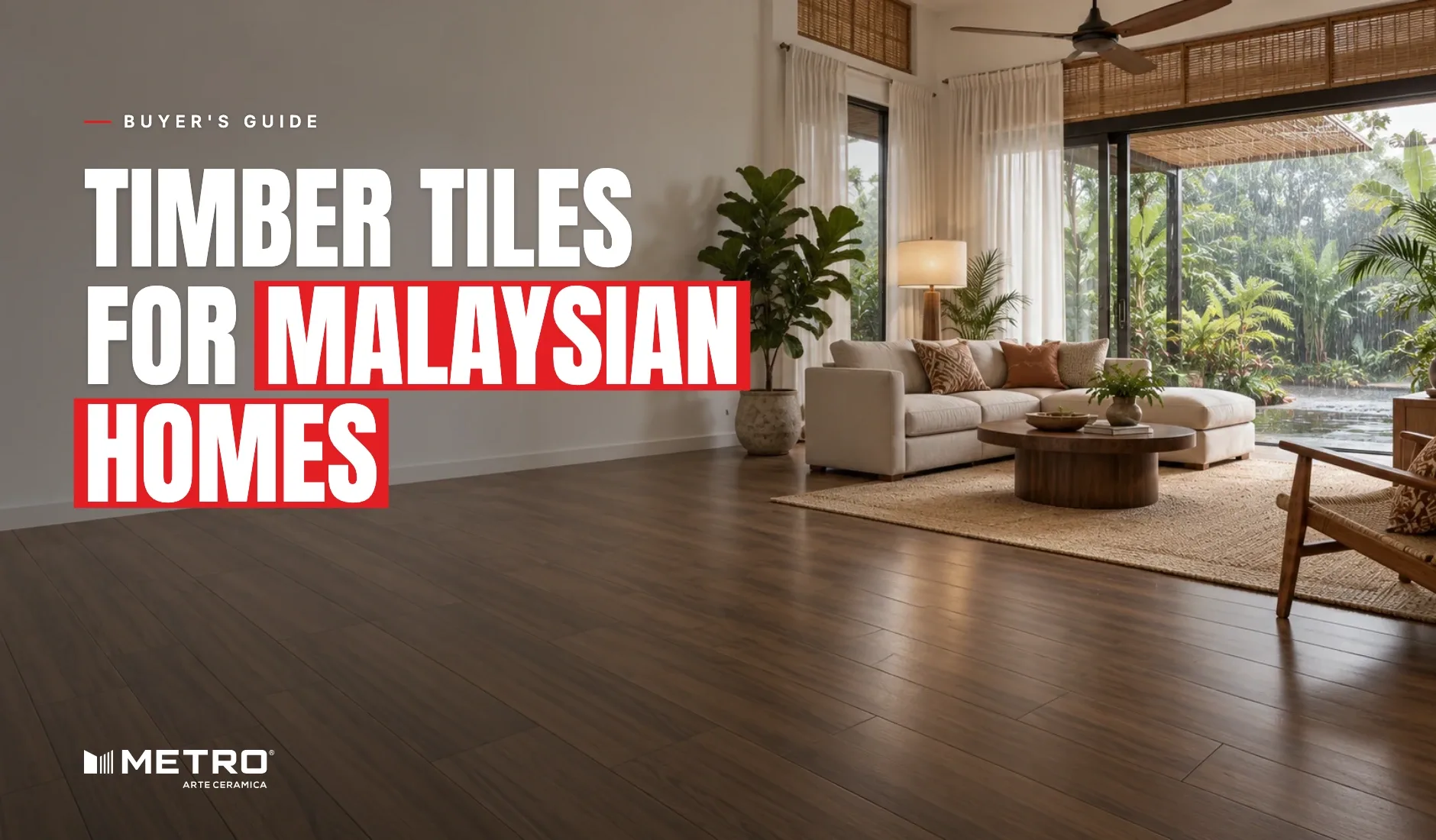
Malaysia's climate is hard on flooring. Year-round humidity, sudden monsoon downpours, and constant heat put real timber flooring under stress it was never designed to handle long-term. Timber tiles solve this by keeping the warm, natural look homeowners want, in a material built for tropical conditions rather than temperate ones.
Why real timber struggles in a tropical climate
1. Constant humidity absorption
Real wood is hygroscopic, meaning it continuously absorbs moisture from humid air. This causes swelling, cupping, and warping that never fully settles in a climate that rarely dries out.
2. Monsoon season exposure
Sudden, heavy rainfall raises indoor humidity fast, and timber flooring near entrances or open verandas takes the brunt of it.
3. Termite risk
Malaysia's climate is highly favourable to termites, and timber flooring in direct or indirect ground contact remains a continuous risk regardless of initial treatment.
4. Mould and mildew
Persistent humidity combined with organic wood material creates ideal conditions for mould growth, particularly in poorly ventilated rooms.
None of this shows up in the first year. It shows up in years three to five, which is what makes timber flooring an expensive mistake in this climate rather than an obvious one.
Why timber tiles handle tropical conditions better
1. Stable water absorption regardless of humidity
Metro's timber tiles carry a water absorption rate of 6 to 8%. Unlike real timber, this stays constant no matter how humid the air is, so there is no swelling, cupping, or warping through monsoon season or year-round humidity. The tile body was tested at that rate and behaves the same in January as it does in November.
2. No organic material for termites or mould
Because the tile body is ceramic rather than wood, there is no organic material for termites to target and no substrate for mould to establish on the surface. In a climate where termite treatment is a recurring household cost, removing the food source entirely is worth more than any treatment schedule.
3. Naturally cool underfoot in tropical heat
Ceramic stays noticeably cooler underfoot than timber flooring in continuous tropical heat. In a climate where indoor temperatures stay high for most of the year, this is a daily comfort difference, not a technical footnote.
4. Curve edge for an authentic plank profile
Metro's curve edge tiles are mould-formed rather than machine-cut flat, which reproduces the rounded profile of a real timber plank. Rectified tiles give a sharp squared edge and are more prone to bending across long formats. On a wide open-plan floor, that bending shows up as lippage between adjacent planks, which is exactly where a timber-look floor stops looking like timber.
5. 3D print technology and random face patterns
Advanced 3D high-definition printing reproduces timber grain and knot detail with real depth. Just as importantly, each design carries multiple random face patterns, so the wood grain texture does not repeat every few tiles across a large room. A visible repeat is the most common giveaway of a low-cost timber-look floor, and it becomes obvious on the open layouts common in Malaysian homes.
6. 9mm thickness for stability
At 9mm, the tile body resists flexing across long plank formats and holds up to the concentrated loads of daily household traffic. Thinner formats quote lower but do not carry the same dimensional stability.
Choosing a size for Malaysian homes
1. 200x1200mm: A practical format for open-plan living and dining areas, reducing grout lines across larger spaces where the floor runs uninterrupted. 2. 150x900mm and 200x1000mm: Suit bedrooms and standard-sized rooms without excessive cutting at the edges. 3. 200x1400mm: The longest plank format, best for large uninterrupted floors where fewer joints make the timber illusion stronger. 4. 80x450mm Chevron: Works well for feature walls or entryway accents rather than full-room flooring.Browse the full size range in the downloadable catalogue.
What to check before ordering tiles for humid climates
1. Water absorption rate
Ask for the tested figure rather than a general "moisture resistant" claim. In this climate the number matters more than the label.
2. Edge type
Confirm curve edge or rectified. Curve edge planks lay flatter across long formats and read closer to real timber.
3. Random pattern count
Fewer than three face patterns per design produces a visible repeat on open-plan floors.
4. Thickness
9mm is the reference point for residential flooring meant to last.
5. Certification
CE and ISO certification confirms the tile has passed standardised quality and dimensional testing. Metro carries both, manufactures at its facility in Morbi, Gujarat, and supplies more than 30 countries.
Installation notes for humid climates
1. Ensure the subfloor is fully cured and completely dry before installation. Trapping residual moisture beneath tile in a humid climate creates problems that surface years later and cannot be fixed without lifting the floor. 2. Use a mould-resistant grout formulation, particularly in bathrooms, kitchens, and any room with limited ventilation. 3. Maintain proper expansion joints, since even ceramic tile experiences some thermal movement across large, temperature-fluctuating spaces. 4. Keep rooms adequately ventilated. Airflow reduces ambient humidity regardless of flooring material, and it protects skirting, doors, and furniture alongside the floor.Get the timber look built for tropical conditions
A home in Malaysia's climate deserves flooring designed for constant humidity and heat, not adapted from a material built for a temperate one. Timber tiles deliver the same warm wood grain look real timber offers, without the swelling, termite risk, or mould concerns that come with it.
Browse Metro's timber tile range or contact us for samples suited to your home.
Frequently asked questions
Are timber tiles suitable for Malaysia's humid climate?
Yes. With a water absorption rate of 6 to 8%, they hold their shape and finish regardless of ambient humidity, unlike real timber flooring which absorbs moisture continuously from humid air.
Do timber tiles get damaged during monsoon season?
No. Because the tile body does not absorb significant moisture, sudden humidity spikes from heavy rainfall do not cause the swelling or warping that affects real timber.
Are timber tiles cooler than real wood in tropical heat?
Yes. Ceramic stays noticeably cooler underfoot than timber flooring during continuous tropical heat, which is a real comfort advantage in Malaysia's climate.
Can termites damage timber tiles?
No. Since the tile is ceramic rather than wood, there is no organic material for termites to target. This removes a recurring treatment cost that timber flooring carries permanently in this region.
What size tile works best for a Malaysian living room?
200x1200mm suits open-plan living and dining areas, since it reduces the number of grout lines across larger spaces. For very large uninterrupted floors, 200x1400mm reduces joints further.
What is the difference between curve edge and rectified timber tiles?
Curve edge tiles are mould-formed with a rounded plank profile that mimics real timber. Rectified tiles are machine-cut to a flat, sharp edge and are more prone to bending across long formats, which produces lippage between adjacent planks after installation.