

15 September 2026 10 min read
Chevron flooring pattern: a layout guide for Australian interiors
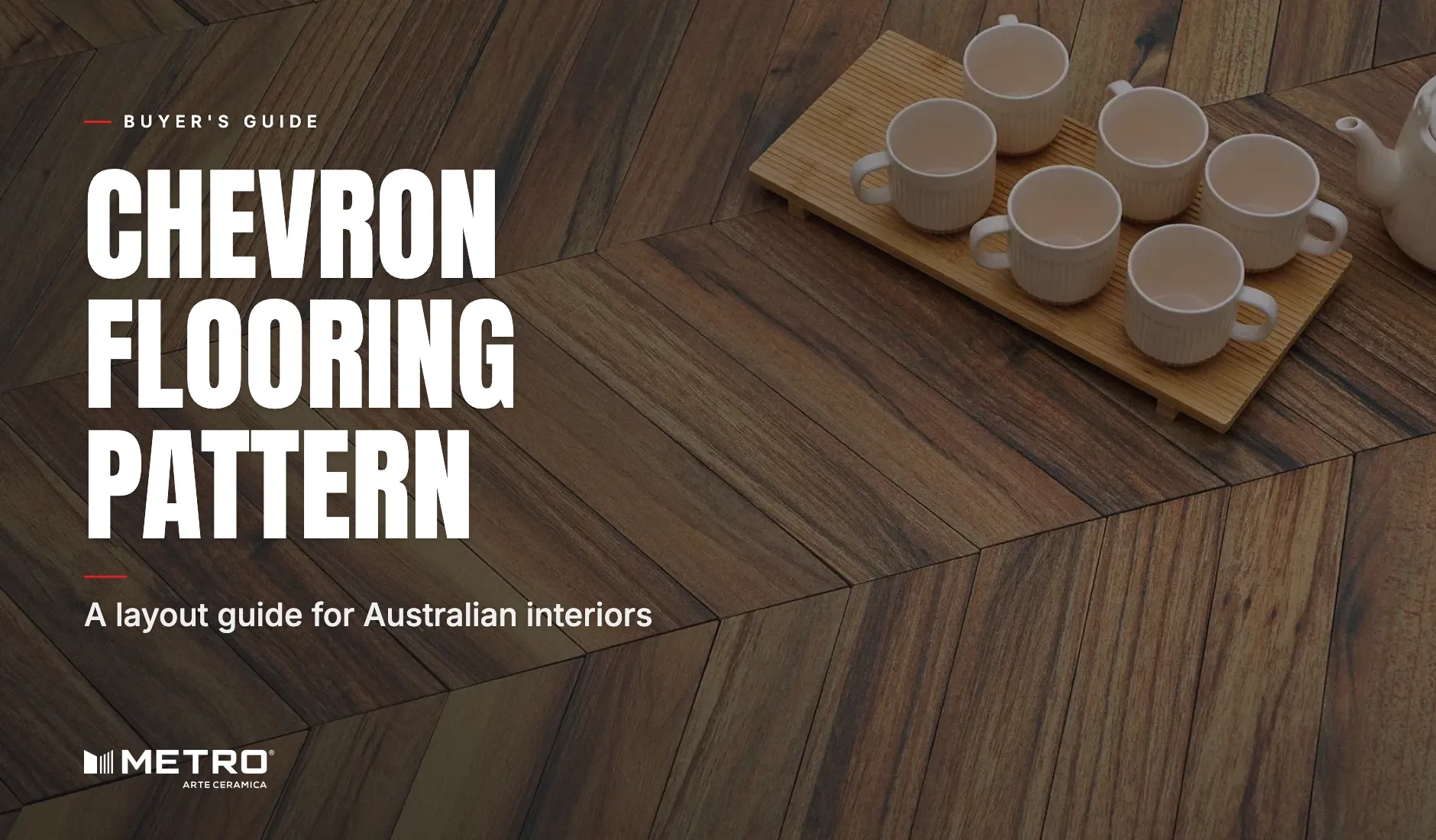
Most tiled floors in Australia run in straight rows. Plank after plank, edge to edge, one direction. It works. It is also the layout equivalent of painting every room white: safe, inoffensive, forgettable.
Chevron flooring does the opposite. Two columns of planks meet at a centre line, angled to form a continuous V. The pattern pulls your eye through the room. It gives a hallway direction, an entryway presence, and a living room, a centrepiece that is not a piece of furniture.
This guide covers the practical side: how chevron differs from herringbone, which tile sizes work where, what your tiler needs to know before laying it, and where the pattern earns its extra cost versus where it does not.
Chevron flooring vs herringbone: the difference that matters
People mix these up constantly. Even some tilers use the terms interchangeably. They are not the same pattern, and picking the wrong one changes the feel of the room.
Chevron planks are cut at matching angles (usually 45 or 60 degrees) so they meet in a clean, continuous V along a centre line. Every joint along that centre is a sharp point. The result is a strong directional pull, like an arrow running the length of the room.
Herringbone uses standard rectangular planks staggered at 90 degrees. The ends of each plank butt against the side of the next one. There is no centre line, no V point. The result is a zigzag that reads as a pattern without a single strong direction.
|
Factor |
Chevron |
Herringbone |
|
Plank shape |
Angled ends (parallelogram) |
Standard rectangle |
|
Centre line |
Clean, continuous V |
No centre line; staggered zigzag |
|
Visual direction |
Strong, pulls the eye one way |
Diffused, reads as texture |
|
Installation precision |
Higher (angles must match exactly) |
Moderate (90 degree butts are forgiving) |
|
Tile waste |
Lower with purpose cut tiles; higher if cutting on site |
Minimal (standard planks, no angle cuts) |
|
Best for |
Hallways, entryways, long rooms, statement floors |
Kitchens, bathrooms, wider rooms, subtle pattern |
|
Cost premium over straight lay |
10% to 15% (purpose cut); 15% to 20% (site cut) |
8% to 12% |
If you want a floor that guides someone through the space, chevron. If you want a floor that adds visual texture without a strong directional pull, herringbone. Neither is better in the abstract. Both depend on the room.
Australian parquetry tradition leans toward herringbone in period homes, but chevron is the pattern gaining ground in new builds and renovations, partly because purpose cut tiles have made it much simpler to install.
Read our previous blog article on Chevron vs Herringbone Flooring: What the Difference?
Why chevron flooring works differently in ceramic than in timber
Real chevron timber flooring, the kind you see in heritage Melbourne terraces and Sydney apartments, is beautiful. It is also expensive, vulnerable to humidity, and a magnet for termites across most of Australia.
Chevron ceramic tile solves the practical problems without losing the pattern. A 150x900mm ceramic plank laid in a chevron pattern looks like timber parquet from standing height. The grain is printed at 3D resolution with tactile ridges you can feel underfoot. The tile is 9mm thick, does not swell in Brisbane humidity, does not attract termites in North Queensland, and does not need sanding or oiling in any climate.
The critical advantage ceramic has over real timber for chevron specifically: dimensional stability. Chevron patterns depend on every plank being exactly the same length and angle. Real timber moves with moisture and temperature. Over a few seasons, tight chevron joints in real timber can gap, buckle, or misalign. Ceramic does not move. The pattern stays locked in.
For straight plank alternatives or room by room comparisons, see the timber look tiles vs real timber guide.
Which chevron flooring tile size to use where
Metro makes chevron tiles in two sizes. Each suits different spaces.
150x900mm (the workhorse)
The 150x900mm chevron collection is the one that covers most projects. Living rooms, hallways, bedrooms, dining areas, and covered entertaining zones. The plank is long enough to read as real timber but manageable for a tiler working to a pattern line across a full room.
At this size, the V pattern is visible and clean without being so large that it overwhelms a standard Australian room. A 4 x 5 metre living room fits the pattern comfortably. A 3 metre wide hallway looks particularly good because the V pulls the eye from the front door toward the back of the house.
80x450mm (the feature)
The 80x450mm chevron collection is built for accent zones, not full rooms. The smaller plank creates a tighter, more detailed pattern that works as a focal point in a specific area.
Where it works best:
A fireplace hearth, a kitchen island base, an entryway rug zone (the tiles replace a rug permanently), a feature section within a larger floor of straight planks. Use it where you want someone's eye to land when they walk into the room, then surround it with standard 150x900mm straight planks or 200x1200mm planks in the same tone.
Do not use 80x450mm across an entire large room. The pattern becomes visually busy at scale, and the installation cost climbs because every tile is a separate alignment point.
What your tiler needs to know installing Chevron flooring
Chevron flooring is not a difficult install for an experienced tiler, but it is a different one from straight lay. A few points worth discussing before work starts.
1. Find the centre line first
Every chevron floor starts from the centre of the room, not from a wall. The V pattern needs to be symmetrical. If the tiler starts from one edge, the pattern will drift and the cuts against the opposite wall will look wrong. Snap a chalk line down the centre of the longest axis, then work outward.
2. Purpose cut tiles save real money
Metro's chevron tiles arrive pre angled. The tiler lays them directly without any on site cutting to achieve the chevron angle. This saves two to four hours on a typical room compared to cutting standard rectangular planks to a 45 degree angle, and it eliminates the tile waste from those cuts (typically 10% to 15% of material).
3. Grout joints matter more in a pattern floor
In straight lay, a slightly uneven grout joint disappears into the row. In chevron, every joint is part of the V, so inconsistencies are visible. Maintain 2 to 3mm joints throughout and use curve edge tiles that naturally accommodate this width. Wider joints at the V point create a visual gap that breaks the pattern.
4. Substrate prep is non negotiable
Chevron amplifies any unevenness in the floor. A high spot that you might ignore in straight lay becomes a raised tile edge in a chevron V. Level the screed properly before laying. The Housing Industry Association and Master Builders Australia both publish substrate preparation guidelines for tiled floors.
5. Curve edge tiles lay better in chevron
Rectified tiles with tight 1mm joints can look precise in a showroom display, but on a real floor with real substrate variation, the tight joints in a chevron pattern crack faster because there is no room for thermal movement. Curve edge tiles with their natural 2 to 3mm bevel joint give the pattern breathing room. Metro manufactures exclusively in curve edge format. The full explanation is in the rectified vs non rectified guide.
Where chevron flooring works best in Australian homes
Hallways and entryways
The strongest application. The V pattern turns a narrow hallway from a pass through space into a design feature. Run the V pointing from the front door inward.
Living rooms with a clear axis
A living room with a focal point at one end (a fireplace, a feature window, a TV wall) gives the V something to point toward. The pattern guides the eye.
Dining rooms
A chevron floor under a dining table creates a grounding effect. Guests notice it. It makes a dining room feel intentional rather than just a table in an open plan.
Covered alfresco areas
Chevron in an outdoor zone is unusual and eye catching. Use the 150x900mm size and a matte finish for slip resistance. For outdoor specific specs, see the timber look tiles for alfresco areas guide.
Where chevron flooring does not earn its cost
Not every room needs pattern. Honesty saves money.
Bathrooms
The room is too small and too cluttered with fixtures for the pattern to read. A toilet, vanity, and shower base break up the V before it develops. Use straight planks in bathrooms and save the chevron budget for a room where it shows.
Kitchens with island benches
A large island in the centre of the floor interrupts the V pattern. Unless the kitchen is very large and the island is offset, the chevron will look cut in half. Herringbone works better in kitchens because it does not depend on a centre line.
Small bedrooms under 10 sqm
The pattern is too dominant for the space. A standard straight lay with the same tile tone feels calmer and makes the room feel bigger.
Laundries
Nobody is admiring the floor pattern between loads.
See chevron in person before committing to the pattern. Request samples of both the 150x900mm and 80x450mm chevron collections and lay a test section on your actual floor to check the scale.
Frequently asked questions
What is the difference between chevron and herringbone flooring?
Chevron planks are cut at angles and meet in a continuous V at the centre. Herringbone uses rectangular planks staggered at 90 degrees in a zigzag. Chevron gives strong direction. Herringbone gives texture.
Is chevron flooring more expensive to install?
Yes. About 10% to 15% more than straight lay when using purpose cut chevron tiles. If your tiler has to cut standard planks to angle on site, the premium is closer to 15% to 20% due to extra labour and material waste.
Can you use chevron tile outdoors?
Yes, in covered alfresco areas with a matte slip rated finish. Avoid chevron on surfaces with complex drainage slopes because the angled joints complicate water flow.
What size chevron tile suits a hallway?
150x900mm. Long enough to show the V pattern clearly in a 3 to 4 metre wide hallway, and manageable for your tiler to align precisely.
Does chevron flooring make a room look bigger?
It makes a room feel longer. The V pattern pulls the eye along the longest axis. In a narrow space like a hallway or corridor, this effect is particularly strong.
Is chevron suitable for an open plan living area?
Yes, if the room has a clear axis or focal point for the V to point toward. In fully open plans without a natural directional anchor, herringbone may read better because it does not depend on orientation.
Why does Metro use curve edge tiles for chevron?
Chevron patterns amplify any tile unevenness because every joint is part of a visible V. Curve edge tiles lay flatter and allow 2 to 3mm grout joints that give the pattern room for thermal expansion. Rectified tight joints in a chevron pattern crack faster on real world substrates.