

12 September 2026 11 min read
Why importers are sourcing wooden tiles direct from Morbi, India
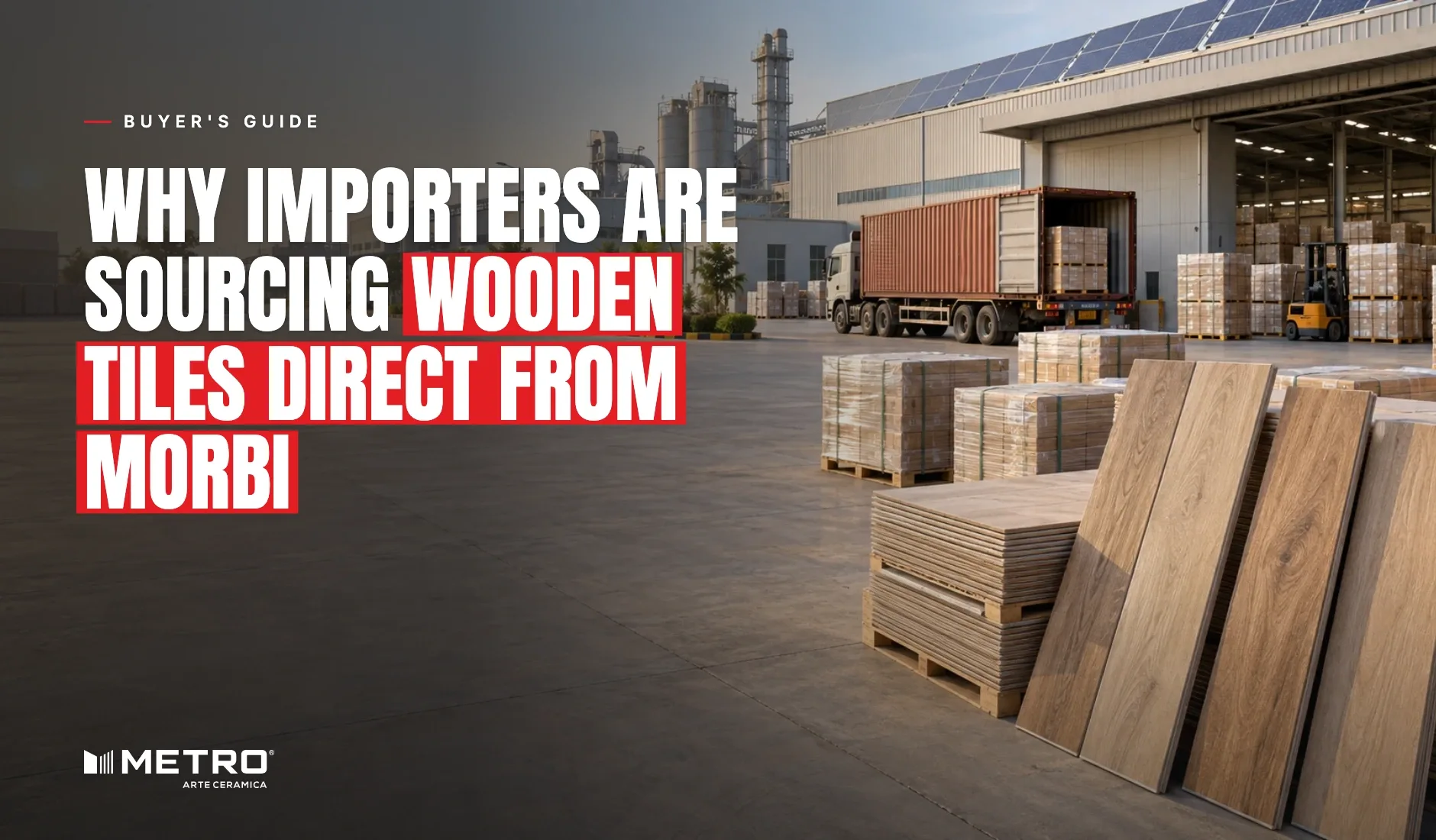
If you import ceramic tiles into the US, Australia, Europe, Southeast Asia, or the Middle East, you already know about Morbi. If you do not, your competitors do.
Morbi is a city in Gujarat, western India. Population under 300,000. And it produces more ceramic tiles per year than most countries. The cluster runs over 900 tile factories across the city and its surrounding area, making it the second largest ceramic tile manufacturing hub in the world after Foshan, China. The Morbi Ceramic Manufacturers Association represents the industry, and the numbers are staggering: billions of square metres of tile produced annually, shipped to 170+ countries.
For importers specifically looking for wooden tiles (wood look ceramic plank tiles), Morbi is where the sourcing conversation starts. Here is why.
What makes the Morbi tiles manufacturing cluster different
Most tile factories in other countries operate as individual companies buying raw materials at market rates, hiring independently, and shipping from the nearest available port. Morbi is not that. It is a cluster economy, and that changes the maths.
Raw material suppliers, glaze manufacturers, printing technology providers, kiln engineers, packaging companies, and logistics operators are all within a 30 kilometre radius. A factory in Morbi can source clay, glazes, inks, moulds, and packaging without anything travelling more than an hour by truck. That density collapses per unit cost in a way that isolated factories cannot replicate.
Labour is another factor. Morbi has decades of tile manufacturing history, which means the workforce is trained. A kiln operator or a printing technician in Morbi has likely worked in three or four factories over their career. The skill base is deep without the labour cost of European or North American manufacturing.
The result: a Gujarat Morbi tiles factory can produce a high quality 200x1200mm wood look plank tile at a cost point that a European or Australian factory cannot match, even before freight is factored in. According to the India Brand Equity Foundation, India is now among the top three ceramic tile exporting nations globally, and Morbi accounts for the majority of that volume.
Why wooden tiles specifically have a sourcing advantage from Morbi
General ceramic tiles are available from dozens of countries. Wooden tiles are different. The format is a plank, not a square. That means longer kilns, more precise temperature control along the length of the tile, and higher rejection rates during quality checks because any warp or bend on a 1,200mm plank is visible in a way that it is not on a 600x600mm square.
Morbi has more factories producing wood look plank tiles than any other cluster outside China. That specialisation matters for importers because it means:
Variety
A single sourcing trip to Morbi can cover dozens of wooden tile factories producing planks from 80x450mm chevron up to 200x1400mm long format, in hundreds of design finishes. You are not limited to one factory's design range.
Competitive quoting
Multiple factories producing the same format creates price competition. An importer can quote from three to five factories on the same spec and get realistic market pricing within days.
Technical capability
Factories that have produced plank tiles for ten or fifteen years have solved the engineering problems (kiln temperature curves for long formats, print registration across 1,400mm surfaces, mould tooling for curve edge profiles) that newer entrants in other countries are still working through.
What Metro Wooden Tiles offers that generalist Morbi tiles factories do not
Most Morbi tiles factories produce everything: floor tiles, wall tiles, porcelain slabs, wooden planks, marble look, stone look, solid colors. Their wooden tile range is one product line among twenty. The kiln runs wooden tiles on Monday and marble look on Tuesday. The R&D team splits its attention across a dozen categories.
Metro does not work that way. Metro manufactures only wooden tiles. That is not a limitation. It is the entire business model.
But the real differentiator is narrower than niche focus alone. Metro is the only manufacturer in India producing wooden tiles in 9mm thickness with a non rectified curve edge profile across every format in the range. Not just in Morbi. In the entire country. Other factories produce wooden tiles, yes. Some produce 9mm tiles. Some produce curve edge tiles. Nobody else combines all three into a single, consistent product line running from 80x450mm chevron to 200x1400mm long format planks.
Full plank format range from a single source
|
Format |
Size |
Application |
|
Chevron |
Pattern floors, feature zones, accent areas |
|
|
Standard plank |
Bedrooms, corridors, bathrooms, walls |
|
|
Mid size plank |
Living rooms, kitchens, offices |
|
|
Long format plank |
Open plan living, master bedrooms, commercial |
|
|
Extra long plank |
Large halls, showrooms, hospitality |
|
|
Designer plank |
Premium residential, mixed material (wood + brass + marble) |
|
|
Chevron |
Purpose cut chevron and herringbone floors |
An importer can fill a container with seven different formats from one factory, one quality standard, one point of contact, one set of shipping documents.
Curve edge (non rectified) exclusivity
Metro manufactures every plank in curve edge format. Not as a cost saving. As a deliberate technical choice.
Rectified plank tiles (edges machine cut after firing) develop a slight bow along their length, particularly in formats above 200x1000mm. That bow causes lipping on installed floors, which generates complaints from end users and returns from retailers. Metro's curve edge manufacturing avoids post firing cutting entirely, so planks lay flat along their full length.
For an importer, this translates to fewer returns, fewer complaints from your distribution network, and a product you can sell on performance rather than just price. The full technical explanation is in the rectified vs non rectified guide.
9mm thickness across the range
Many Morbi factories offer 6mm or 7mm wooden tiles as the standard thickness because thinner tiles cost less to produce. Metro standardises at 9mm across every format.
9mm gives the plank a solid underfoot feel that thinner tiles lack. It also reduces breakage during shipping (a real cost issue for importers filling 20 foot containers) and handles the point loads from heavy furniture without cracking. When your buyer picks up a Metro tile and compares it side by side with a 6mm competitor, the 9mm tile wins the sale on feel alone.
3D high definition printing with random face patterns
Every Metro tile is printed with multiple random face patterns per design, typically four to five per SKU. No two adjacent tiles on an installed floor look identical. This is the spec that separates tiles that look like photographs of wood printed on ceramic from tiles that genuinely pass for real timber flooring at standing height.
For an importer selling to architects, designers, or high end retailers, random face patterns are a selling point that budget tiles from generalist factories cannot match.
Cheaper than real wood, with none of the maintenance
Here is the number that closes deals with distributors selling to end users: ceramic wooden tiles cost a fraction of real hardwood flooring, last longer, and need zero maintenance over their lifetime. No sanding, no polishing, no sealing, no termite treatment, no replacement boards.
Real timber flooring in most international markets runs 3x to 5x the cost of ceramic wooden tiles per square metre at the point of purchase, and then adds annual maintenance costs on top. An importer positioning Metro's tiles as "the look and feel of real timber at a fraction of the price with zero upkeep" has a value proposition that sells in every market, from Australia to the US to the Middle East.
Certifications that open doors in export markets
CE certification
Required for selling into the European Union and increasingly expected by specifiers in Australia, the Middle East, and Southeast Asia. CE marking confirms the tile meets European standards for dimensional accuracy, water absorption, breaking strength, and slip resistance. Metro holds CE certification across its full product range.
ISO certification
ISO certification covers the manufacturing process: quality management systems, consistency of output, traceability of materials. For an importer building a relationship with a new factory, ISO certification is the fastest proof that the factory runs a systematic quality process rather than relying on batch by batch inspection.
Both certifications are verifiable. Ask for the certificate numbers during your enquiry and confirm them independently.
The pricing conversation (what importers actually want to know when importing tiles)
This article will not list specific per square metre prices because they vary by volume, format, finish, shipping terms, and payment structure. What it will do is explain the cost structure so you know what to ask.
Format drives base price
A 150x900mm plank costs less per square metre to produce than a 200x1400mm plank. The larger format uses more raw material, needs a longer kiln cycle, and has a higher rejection rate. Expect the price per square metre to increase as the format gets longer.
Thickness drives material cost
9mm uses more clay body than 6mm. A factory offering the same format at a lower price is probably offering thinner tiles. Always confirm thickness when comparing quotes.
Print quality drives the gap between budget and premium
A tile with flat digital printing and one repeating face pattern is cheaper to produce than a tile with 3D textured printing and five random face patterns. Both are "wood look tiles." They are not the same product.
Curve edge vs rectified affects tooling cost
Curve edge mould tooling costs more than standard flat moulds. Rectified tiles require a post firing grinding line. The cost impact is similar, but the performance difference is not.
Shipping terms change the landed number
FOB Mundra (the nearest major port to Morbi, operated by Adani Ports) is the standard export term. CIF to your destination port adds freight and insurance. Ask for both numbers to understand the factory gate price versus the landed price in your market.
MOQs vary by factory
Metro's minimum order quantities depend on format and finish. Confirm during your initial enquiry rather than assuming.
How to start a sourcing conversation with Metro
If you are an importer, distributor, or building material wholesaler evaluating wooden tile suppliers from Morbi, here is what a typical enquiry looks like.
First contact
Reach out through the contact page or the export page with your target market, approximate annual volume, preferred formats, and shipping terms (FOB or CIF). Metro's export team responds with a preliminary quote and a digital catalogue.
Sample stage
Request physical samples of specific designs and formats. Samples ship internationally. Evaluate the tile in person: check the thickness with calipers, inspect the print quality, feel the curve edge profile, lay two tiles side by side and confirm they sit flat.
Factory visit (optional but recommended)
Morbi is accessible via Rajkot airport (45 minutes by road) or Ahmedabad airport (3.5 hours). Metro welcomes factory visits from prospective partners. You see the kiln, the printing line, the quality check process, and the finished goods warehouse. Most importers who visit Morbi place their first order within two weeks of the trip.
Trial order
A single container (typically 1,200 to 1,500 sqm depending on format) to test the product in your market, evaluate the shipping process, and confirm the landed quality matches the sample.
Ongoing supply
Repeat orders with established lead times, consistent quality, and a dedicated account contact.
Learn more about Metro's manufacturing and values on the about page, or explore Metro's sustainability practices if your market values environmental credentials.
Frequently asked questions
What certifications does Metro hold for export?
CE and ISO certified across the full product range. Both certifications are verifiable by certificate number. CE is required for EU markets and increasingly expected in Australia, the Middle East, and Southeast Asia.
What is the minimum order quantity for export?
MOQs vary by format and finish. Contact Metro's export team with your target formats for specific numbers. Trial orders typically start at a single container (1,200 to 1,500 sqm).
Does Metro make porcelain tiles?
No. Metro manufactures ceramic wooden tiles with 6% to 8% water absorption at 9mm thickness. If your market specifically requires porcelain grade (under 0.5% absorption), confirm this during your enquiry.
How close is Morbi to a shipping port?
120 kilometres from Mundra Port, about three hours by road. Mundra is India's largest private port with direct container routes to Europe, the US, Australia, the Middle East, and Southeast Asia.
Can Metro supply private label or custom packaging?
Contact the export team directly for private label and custom packaging enquiries. Many Morbi factories offer this, and Metro can confirm availability and minimums during your initial discussion.
What makes Metro different from other Morbi tiles manufacturers?
Single category focus (wooden tiles only), exclusive curve edge manufacturing, 9mm standardised thickness, 3D printed random face patterns, and CE plus ISO certification. Most Morbi factories are generalists producing twenty product categories. Metro produces one.