

09 September 2026 10 min read
Wooden tiles price in India (2026): what actually decides what you pay
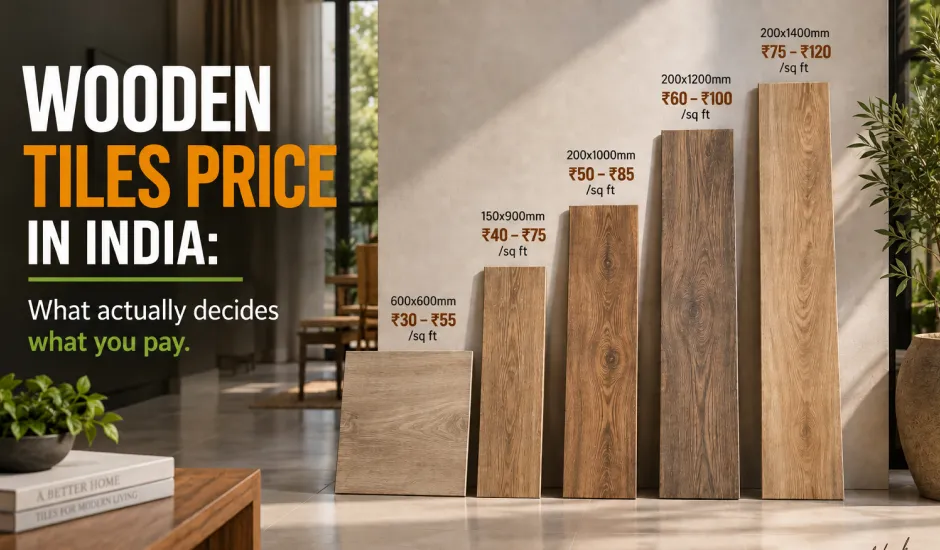
Walk into any tile showroom in India today and ask for wooden tiles. You will get quotes ranging from ₹30 per sq ft to ₹150 per sq ft, sometimes for tiles that look nearly identical at first glance. The gap is confusing, and most showrooms are not great at explaining it.
The wooden tiles price you pay depends on five things: The size of the tile, its thickness, the print and finish quality, the edge profile, and the brand. This guide breaks down each factor with actual 2026 price ranges so you know what is reasonable before you walk into a showroom or place an order online.
Wooden tiles price in India
Here is what wooden floor tiles cost across formats in India right now. These are market ranges across brands, not any single brand's rate card.
|
Format |
Typical size |
Price range (₹/sq ft) |
Price range (₹/box approx) |
Who buys this |
|
2x2 (square) |
600x600mm |
₹30 to ₹55 |
₹800 to ₹1,400 |
Budget renovations, rental properties, commercial spaces needing fast coverage |
|
Standard plank |
150x900mm |
₹40 to ₹75 |
₹1,000 to ₹1,800 |
Bedrooms, corridors, balconies; most popular entry point for plank tiles |
|
Mid-size plank |
200x1000mm |
₹50 to ₹85 |
₹1,200 to ₹2,100 |
Living rooms, kitchens, offices; wider plank for a more natural wood look |
|
Long-format plank |
200x1200mm |
₹60 to ₹100 |
₹1,500 to ₹2,500 |
Open-plan living areas, master bedrooms; fewer grout lines across the floor |
|
Extra-long plank |
200x1400mm |
₹75 to ₹120 |
₹1,800 to ₹3,000 |
Large halls, showrooms, premium residences; closest look to real hardwood flooring |
|
Chevron plank |
80x450mm / 150x900mm |
₹55 to ₹90 |
₹1,300 to ₹2,200 |
Feature floors, entryways, accent patterns; higher installation cost due to angled laying |
|
Designer / premium |
203x1010mm (e.g. Diamante) |
₹80 to ₹150 |
₹2,000 to ₹3,800 |
Statement floors; mixed textures like wood + brass profiles, random patterns |
2x2 wooden floor tiles price
The wooden floor tiles 2x2 price is the most searched pricing query in this category. It is also the cheapest format because 600x600mm tiles use less material per unit and are faster to manufacture than plank formats.
But here is what the price does not tell you: A 2x2 square tile does not look like wood flooring. Real wood comes in planks, not squares. The moment you lay square tiles on a floor, the grid pattern breaks the wood illusion regardless of how good the surface print is. You save ₹10 to ₹30 per sq ft upfront, but the floor never quite looks like the hardwood aesthetic you were going for.
Plank formats starting at 150x900mm cost more per sq ft, but they produce the long, directional lines that make a tiled floor actually pass for real wood. If the goal is a genuine wood-flooring look, plank tiles deliver it and 2x2 tiles do not. That price difference is buying you a completely different visual result.
Metro manufactures exclusively in plank formats ranging from 80x450mm to 200x1400mm. Browse the 150x900mm plank collection or 200x1200mm planks to see the difference in person.
Five things that actually drive wooden tiles price
1. Size and format
This is the single biggest price driver. Larger planks cost more to manufacture because they need more raw material per tile, larger kilns, tighter quality control (a 200x1400mm plank that warps by 1mm is visible; a 600x600mm tile with the same warp is not), and they produce more waste during cutting. The jump from 150x900mm to 200x1200mm adds roughly ₹15 to ₹25 per sq ft across most brands.
2. Thickness
Thickness is the spec most buyers overlook and most showrooms do not volunteer. Wooden tiles in India come in 6mm, 7mm, 8mm, and 9mm options. The difference matters.
A 9mm tile is the thickness benchmark for premium wooden tiles. It feels solid underfoot, handles heavy furniture without cracking, and lasts longer under daily traffic. Thinner tiles (6 to 7mm) cost ₹5 to ₹15 less per sq ft but feel hollow when tapped, crack more easily under point loads like bed legs or heavy almirahs, and wear faster in high-traffic zones.
If someone quotes you a surprisingly low wooden tiles rate for a large-format plank, check the thickness first. A 200x1200mm tile at 6mm thickness is cheaper to make than the same size at 9mm, but you are paying for a tile that compromises on the one spec that determines how it performs over 10 to 15 years.
3. Print and finish quality
The surface of a wooden tile is a printed glaze fired at high temperature. The quality of that print determines whether the tile looks like real wood or like a photograph of wood stuck to a flat surface.
Premium tiles use 3D high-definition printing that creates actual surface texture you can feel with your fingertips: grain ridges, knot indentations, pore detail. Budget tiles use flat digital printing with no surface variation. The price gap between the two is ₹10 to ₹30 per sq ft, and the visual gap is immediately obvious when you see them side by side.
Random face patterns also affect price. A tile with 3 to 5 random patterns per design means no two adjacent tiles look identical on the floor, which is how real wood works. A tile with one repeating pattern is cheaper but creates a visible repeat every few tiles that kills the natural look.
Metro's Diamante collection carries 5 random patterns per design with wood, brass-profile, and marble-inspired textures, which is why it sits at the premium end of the range.
4. Edge profile: curve edge vs rectified
This affects both price and long-term performance. Rectified tiles have edges machine-cut after firing for tight grout joints. Curve edge (non-rectified) tiles keep the natural edge formed by the mould.
Curve edge planks cost slightly more to produce because the mould tooling is more complex. But they lay flatter, resist the bending that rectified planks develop during firing, and produce the natural plank-to-plank feel of real wood flooring. Rectified planks can look impressive in the showroom but develop visible unevenness after installation because of that bending.
Metro manufactures exclusively in curve-edge format. Read the full rectified vs non-rectified guide for the detailed technical comparison.
5. Brand and manufacturing origin
Tiles manufactured in Morbi, Gujarat, India's largest ceramic tile hub, benefit from cluster economics: shared infrastructure, raw material access, skilled labour, and competitive energy costs. This keeps the wooden flooring cost per square foot lower than tiles manufactured in smaller, isolated facilities.
Certifications also factor into price. CE and ISO certified tiles go through additional quality testing that uncertified tiles skip. That testing costs money, but it means the tile meets international standards for dimensional accuracy, surface hardness, and water absorption. Metro holds both CE and ISO certifications and manufactures in Morbi with decades of production experience.
Wooden tiles vs real wood flooring: the cost comparison
The wooden tiles price only tells half the story. Real wood flooring has a higher upfront cost and a dramatically higher lifetime cost.
|
Cost factor |
Wooden ceramic tiles |
Real hardwood flooring |
Laminate flooring |
Vinyl flooring |
|
Material cost (₹/sq ft) |
₹30 to ₹150 |
₹150 to ₹600 |
₹40 to ₹120 |
₹30 to ₹80 |
|
Installation (₹/sq ft) |
₹15 to ₹30 |
₹40 to ₹100 |
₹10 to ₹20 |
₹8 to ₹15 |
|
Annual maintenance |
₹0 (sweep and mop) |
₹5 to ₹15/sq ft (polish, seal) |
₹0 to ₹5/sq ft |
₹0 |
|
Lifespan |
15 to 25 years |
20 to 40 years (with maintenance) |
8 to 12 years |
5 to 10 years |
|
Termite risk |
Zero |
High |
Low |
Zero |
|
Water resistance |
Full (6 to 8% absorption) |
Poor (warps and cups) |
Poor (swells at joints) |
Good |
|
10-year total cost (₹/sq ft) |
₹45 to ₹180 |
₹250 to ₹850 |
₹80 to ₹260 |
₹70 to ₹175 |
The wooden flooring cost in India makes real hardwood a premium choice best suited to dry, climate-controlled rooms. For kitchens, bathrooms, balconies, and any room that sees moisture, ceramic wooden tiles are the more practical and cheaper long-term option. Laminate and vinyl compete on upfront price but lose on lifespan and water resistance.
This matters when you are budgeting for a full home. A 1,200 sq ft flat tiled entirely in 200x1000mm wooden planks at ₹65/sq ft costs roughly ₹78,000 in material. The same area in mid-range hardwood at ₹300/sq ft costs ₹3,60,000, nearly five times more, and then needs ₹15,000 to ₹20,000 in annual maintenance on top. The Indian Green Building Council also recognises ceramic tiles as a more sustainable building material than harvested hardwood.
How to get the best value without overpaying
Three practical rules when comparing wooden tiles price across brands and showrooms:
Compare per square foot, not per box. Box sizes vary between brands and formats. A ₹1,500 box that covers 12 sq ft is cheaper per sq ft than a ₹1,200 box that covers 8 sq ft. Always divide the box price by coverage area before comparing.
Check thickness before comparing price. A tile that seems ₹10 cheaper per sq ft but is 6mm instead of 9mm is not a saving. It is a different product category. Compare 9mm to 9mm.
Ask about random face patterns. A tile with one repeating design is cheaper to produce. A tile with 4 to 5 random faces costs more but looks dramatically better once installed. This is the one spec where spending more per sq ft has the most visible impact on the finished floor.
Conclusion
The wooden tiles price you see on a rate card is the starting point, not the full picture. Size, thickness, print quality, edge profile, and long-term maintenance cost all shape what you actually pay over the life of the floor. Compare on specs, not just on sticker price, and the numbers tell a clearer story.
For Metro's collection-specific pricing and to see how curve-edge planks compare in person, request a quote or order free samples delivered to your doorstep.
Frequently asked questions
What is the starting price for wooden tiles in India?
Basic 2x2 (600x600mm) wooden floor tiles start around ₹30 per sq ft. Plank format tiles (150x900mm and above) start around ₹40 per sq ft. The price increases with size, thickness, print quality, and edge profile. For Metro's specific pricing across collections, request a quote directly.
Why are plank tiles more expensive than 2x2 tiles?
Plank formats use more raw material per tile, require larger kilns, have tighter quality tolerances (any warp or bend is visible on a long plank), and produce more production waste. The extra cost buys a floor that actually looks like real wood planks rather than a square grid with a wood print.
Is 9mm thickness worth the extra cost?
Yes. 9mm is the industry benchmark for premium wooden tiles. It gives a solid underfoot feel, handles heavy furniture without cracking, and lasts 15 to 25 years under daily traffic. Thinner tiles (6 to 7mm) cost less upfront but wear faster and feel hollow, especially in living rooms and corridors.
How does the metro wooden tiles price compare to other brands?
Metro's pricing sits in the mid-to-premium range because every tile is 9mm thick, curve-edge, and printed with 3D high-definition technology with multiple random face patterns. The curve-edge format and niche plank-only manufacturing keep quality consistent across the range. Contact Metro directly for collection-specific rates.
Are wooden tiles cheaper than real wood flooring?
Significantly. Ceramic wooden tiles cost ₹30 to ₹150/sq ft with zero annual maintenance. Real hardwood costs ₹150 to ₹600/sq ft plus ₹5 to ₹15/sq ft annually for polishing and sealing. Over 10 years, ceramic wooden tiles cost roughly one-third to one-fifth what hardwood costs for the same area.
What is the wooden tiles rate for a full 3BHK flat?
For a typical 1,200 sq ft 3BHK flat using 200x1000mm collection planks at mid-range pricing (₹55 to ₹85/sq ft), expect ₹66,000 to ₹1,02,000 in tile material cost. Add ₹15 to ₹30/sq ft for installation, adhesive, and grouting. Total flooring budget: roughly ₹84,000 to ₹1,38,000 including labour.
Does tile size affect installation cost?
Yes. Larger tiles cover more area per piece, which means fewer cuts, less grout, and faster laying. But very large formats (200x1400mm) need two people to handle and require a perfectly level substrate, which can add to preparation cost. The sweet spot for balancing tile cost and installation cost in most Indian homes is 200x1000mm or 200x1200mm.