

27 September 2026 8 min read
Wood tile flooring for tropical climates: why owners switch
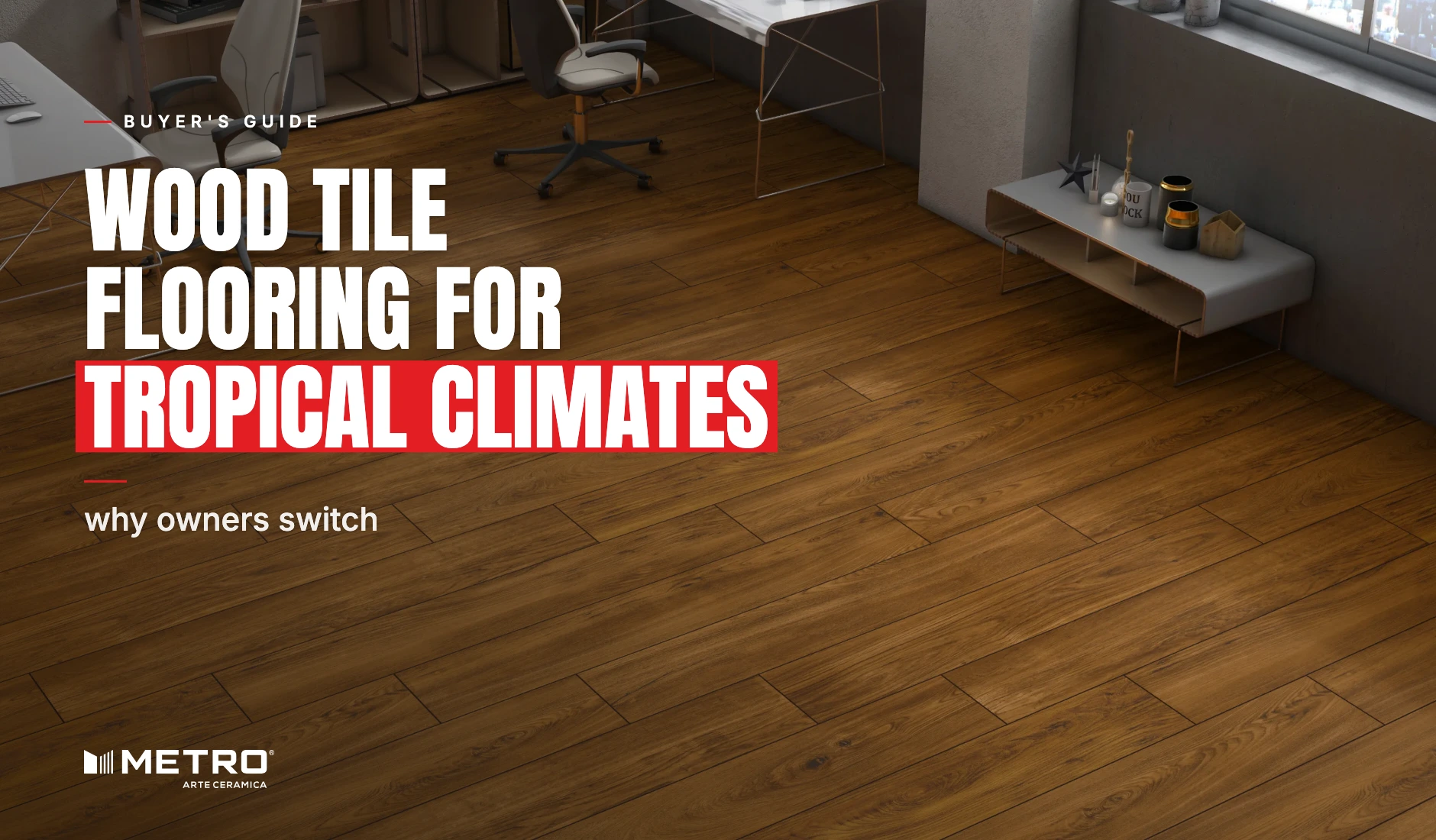
Most flooring sold in Malaysia is tested somewhere drier than Malaysia. That is the quiet problem behind a lot of replaced floors. It is also why wood look tiles keep winning in homes that have already been through one floor.
This guide is about the two comparisons that actually come up: wood look tiles against laminate, which is the cheaper alternative most people weigh first, and wood look tiles against solid timber. It also covers termites and how to choose a size for the kind of home you live in.
What the humidity actually does
The numbers are worth seeing. The Malaysian Meteorological Department puts the mean relative humidity in Peninsular Malaysia at a low of about 80% in February, rising to 88%. The maximum daily average runs over 94%, and it changes little from place to place.
There is no dry season for a floor to recover in. That matters because of how wood behaves. The USDA Forest Products Laboratory's Wood Handbook sets out the mechanism: wood is hygroscopic, taking on moisture from the surrounding environment and giving it back, with shrinkage and swelling as the result.
Where the air stays humid all year, timber sits swollen. Boards cup, joints tighten and then gap, and the finish lifts where the floor meets a wet area. None of this shows up in the first year. It shows up in years three to five, which is what makes timber flooring an expensive mistake in this climate rather than an obvious one.
A fired ceramic body does not take up moisture from the air at all. The floor you lay in a wet month is dimensionally the same floor in a dry one.
Wood look tiles or laminate
Laminate is the honest competitor here, so it deserves a fair comparison rather than a dismissal.
What laminate is. A printed decorative layer over a core of high density fibreboard, which is compressed wood fibre. That core is the issue. It is a wood product, so the same hygroscopic behaviour applies, and it swells from the edges inward when moisture reaches it.
Where it goes wrong. Swelling at a laminate joint does not reverse. Once an edge has lifted, the plank is replaced rather than repaired, and matching a discontinued decor years later is difficult. Put it in a wet kitchen, a ground floor hall that takes wet shoes, or beside a washing machine, and laminate is working against the climate.
Where laminate is a reasonable choice. An air conditioned bedroom in a condominium unit, upstairs, away from water. It is warmer and softer underfoot than tile, it goes down quickly, and it needs no wet trades. If that describes the room, laminate is not a mistake.
On cost. Laminate is cheaper to buy. The comparison that matters is cost per box and per square metre against how long the floor stays acceptable. Factor in how much of the house has to be closed off when it is replaced. Compare those two numbers, not just the first one.
What tiles give up. Ceramic is harder and cooler underfoot. In Malaysia the cool is usually welcome, but the hardness is real and worth standing on before you commit a whole floor.
Termites
This belongs in the comparison rather than in a footnote.
Subterranean termites are a working risk in Malaysian homes, and anything made of wood fibre is food. That includes solid timber, engineered boards and the fibreboard core inside laminate. Treatment and monitoring are ongoing costs where the risk is present.
A fired ceramic tile is not a food source. No sealing, no polishing, no swelling in humidity and no termite risk, which matters in a climate that runs humid all year.
Be clear about what this does not do. Tiling a floor does not protect the structure around it, the door frames or the roof timbers. It takes the floor itself off the menu, which is worth having, and it is not a termite treatment.
Choosing a size for your kind of home
The right plank depends more on the layout than on taste.
Terrace house. The ground floor hall usually runs long and narrow from the front door to the back. A longer plank suits it. At 200x1400mm the plank crosses a terrace house hall with fewer joints than the 1200 mm size, which reads as a calmer floor rather than a busier one. Run the planks along the length of the hall.
Condominium unit. Living halls in a new launch unit are wider and squarer. The 200x1200mm is the balanced choice, and running one colour from the living hall through the bedrooms makes a compact unit feel larger. Check the height you can add at the entrance door and at any threshold to a balcony.
Semi-D and bungalow. More floor, more sight lines, and often a staircase landing visible from below. Longer planks work, and this is where design variety earns its keep, because the same decor may run across several rooms.
Wet kitchen, car porch, patio and pool deck. Use a Matt Texture design here. The surface has grain relief you can feel underfoot, which is what gives grip when the floor is wet. Households with elderly parents ask about grip before they ask about colour, and that is the correct order.
The narrowest plank, 150x900mm, stays useful in smaller rooms and on staircase treads, and it has the widest choice of decors.
On colour, the local timbers are the reference most people have in their heads. Golden honey is the warm golden brown of chengal before it silvers, while the greys read closer to weathered balau than to fresh merbau.
What to check before ordering
Edge type. Metro makes curve edge only, which is what the trade calls non rectified. The edge is formed in the mould, so it stays softly rounded like a real board and the joint reads as a shadow line. Plan for a real joint of 3 to 5 mm rather than trying to close it up.
Random faces. Each design is printed with several randomised faces so neighbouring planks are not identical. The count is set per design, so ask for the figure on the one you have chosen.
Material. Glazed ceramic, with water absorption of 6 to 8% in the body under the glaze, and a breaking strength of 27 to 29 N/mm². We do not make porcelain, and we would rather say so than let the word pass.
Batch and calibre. Every box carries a calibre code. Order the whole area in one go and lay a room from one calibre and one batch.
The downloadable catalogue lists every design by size.
The short version
In a climate that never gives a floor a dry month, the material decides the outcome more than the finish does. Laminate suits a dry upstairs bedroom. For a ground floor hall, a wet kitchen or a car porch, water and termites are part of normal life. There, a fired ceramic plank is the floor that stops being a decision once it is laid.
Browse Metro's wood look tile range or contact us for samples suited to your home, and test them under your own lighting before you commit. For more on how these tiles handle the monsoon, read our guide to wood look tiles in Malaysian homes.
Frequently asked questions
Are wood look tiles better than laminate in Malaysia?
For ground floor halls, wet kitchens and anywhere near water, yes, because laminate has a wood fibre core that swells when moisture reaches the edges and does not recover. Upstairs in a dry, air conditioned bedroom, laminate is a reasonable choice.
Do wood look tiles warp in humidity?
No. A fired ceramic body does not take up moisture from the air, so the plank does not cup, gap or swell the way solid timber and fibreboard cores do. This is the main reason owners switch after replacing a timber floor once.
Can termites damage wood look tiles?
No, a fired ceramic tile is not a food source. It does not protect the rest of the house, though, so door frames, cabinetry and roof timbers still need whatever treatment your home would normally have.
Which size suits a terrace house hall?
200x1400mm or 200x1200mm, run along the length of the hall, so the floor crosses with fewer joints. In smaller rooms and on staircase treads, 150x900mm is easier to work with and has the widest choice of decors.
Are wood look tiles slippery in a wet kitchen?
Surface decides it. A matt, textured face with grain relief holds grip far better than a smooth or glossy one, so use a Matt Texture design in wet kitchens, car porches and pool decks. Ask your supplier for the tested slip figure for the exact design.
Can I use the same tile indoors and on the patio?
Yes. Every design can be used on outdoor floors, including patios, car porches, balconies and pool decks. Take the same colour in a Matt Texture design for the outdoor areas, so the floor runs through without a change of tone.