

24 October 2026 7 min read
Chevron vs herringbone tile: the difference, and which to choose
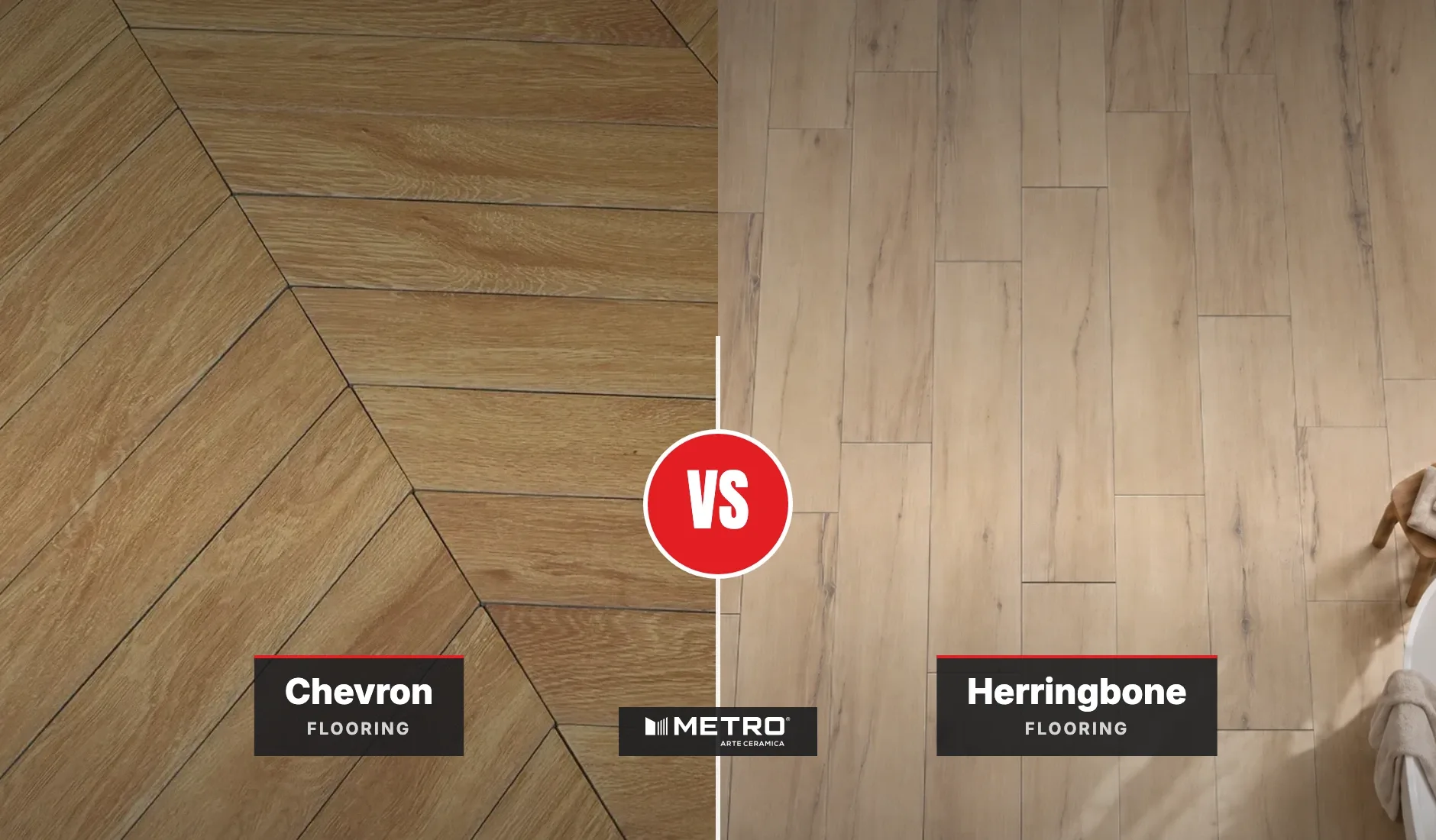
Stand in an entryway and look down a floor laid in Vs. If every point closes into a clean, continuous arrow, you are looking at chevron. If the zigzag steps, with the end of each plank butting against the side of the next, that is herringbone. People search the two names as if they were one pattern, and half the flooring photos online label them wrong.
The difference decides what you buy, what your installer does, and what the floor costs to lay. Here is how to tell them apart and how to choose, in wood look ceramic tile.
The difference in one look
Chevron planks have their short ends cut at an angle. A left plank and a right plank meet end to end and close into a V point. The points line up on one straight center line, and the Vs run as a continuous arrow down the room.
Herringbone planks are ordinary rectangles with square ends. The end of one plank butts against the long side of the next at 90 degrees, so the zigzag steps instead of closing into a point.
Quick test when a photo confuses you: follow one V to its tip. A closed point is chevron. A staggered step is herringbone.
How each is made in wood look tile
Chevron comes pre-cut
Our chevron collection is made as chevron. Every tile leaves the factory marked L or R with the angle already cut, in 150x900mm (6 x 36 in) and 80x450mm (3.2 x 18 in). Your installer alternates left and right, and the points meet without cutting a single angle on site, except at the walls. The collection has 51 designs, all in the matte Texture surface, 8 mm thick.
Herringbone is laid from standard planks
Herringbone needs no special tile. Any of our rectangular wood look planks lay into herringbone, in any size from 150x900mm (6 x 36 in) up. The narrower the plank, the finer the weave reads.
Like every tile we make, both carry a curve edge formed in the mold, so each piece reads as a board and the joint reads as the shadow line between boards. The body is glazed ceramic that absorbs 6 to 8%, group BIIb under EN 14411; porcelain is classified below 0.5% absorption, a difference ASTM explains here. The glaze on top is what faces the room in both patterns.
What each pattern costs to lay
Neither pattern is a budget straight-lay, but they differ.
- Chevron in pre-cut tile removes the angle cuts that make chevron expensive in hardwood. The extra labor sits in the layout: the floor starts from a center line, not a wall, and every point has to meet exactly.
- Herringbone has no angled ends to match, but more pieces and more cuts at the walls, and the stepped layout still takes longer than a straight lay.
- Both patterns waste more tile at the walls than a straight lay. Buy 10% extra at the time of order and store what is left; it is cheap insurance.
Which suits your room
- Chevron, 150x900mm: one left-right pair spans about 61 inches. That wide V wants an open-plan room, a living room or a long hallway where the arrow can run toward a window or the far wall. Treviso carries 10 different faces, so the Vs repeat without repeating.
- Chevron, 80x450mm: one pair spans about 45 inches, so the pattern reads as fine texture. Entryways, powder rooms, a kitchen backsplash, a fireplace wall. Madera Teak has 72 faces in this size.
- Herringbone: the forgiving choice for rooms with many doorways and closets, since square-cut planks handle interruptions better. It also lets one design run from a herringbone entry into a straight-laid living room: the same Oaklore Walnut tone exists as chevron and as a standard plank in every size.
- Direction matters more than people expect. Vs running the length of a room pull the eye to the far end and make it feel longer. Across a wide room you get more repeats and a busier floor. Decide with the furniture plan, because a sofa covers more pattern than you think.
Where neither pattern earns its cost
A small, chopped-up room with cabinets and closets on every wall cuts most planks short, and the pattern never develops. In those rooms a straight lay in a narrow plank looks calmer and costs less. Telling you that up front costs us a sale in some rooms, but a pattern you only see in the corners is not worth the labor.
What your installer needs to know
- Dry lay first. Chevron starts from the room's center line, where the Vs peak. Mark it, snap chalk lines, and lay a section dry before any thinset goes down.
- Alternate left and right. Chevron tiles come 4 left and 4 right per box (15 and 15 in 80x450mm). Order equal numbers; one hand alone cannot form the pattern.
- Joints: minimum 2 mm on chevron, kept with spacers; our rectangular planks in herringbone take a 3 to 5 mm joint for the curve edge.
- Grout color: slightly contrasting grout sharpens the V on 150x900mm; tone-matched grout suits 80x450mm.
- Cure before grouting. Let the bed cure 3 to 4 days; the angled tips are the most likely to shift if grouted early.
- Pick the laying pattern by number. We publish ten chevron laying patterns on every design page; patterns 01 to 04 suit most homes. Write the number on the drawing.
The short version
Chevron closes into a clean V and comes pre-cut as lefts and rights; herringbone steps, and lays from any standard plank. Big open room and a long sight line: chevron, in 150x900mm. Small room, close viewing or lots of doorways: 80x450mm chevron or herringbone in a narrow plank. You can see every design, check the specs in the catalog, or talk to our team with a sketch of the room and we will check the quantities, including the left-right split.
Frequently asked questions
What is the difference between chevron and herringbone?
Chevron planks have angled ends that meet in a clean V point along a straight line. Herringbone planks are square-cut rectangles that interlock at 90 degrees, so the zigzag steps instead of closing.
Is chevron or herringbone more expensive to install?
In tile, chevron's angles come pre-cut, so the cost sits in the center-line layout and exact point matching. Herringbone means more pieces and wall cuts. Both cost more to lay than a straight pattern.
Do I need special tile for herringbone?
No. Herringbone lays from any rectangular plank tile. Chevron is the pattern that needs purpose-cut tile, which is why ours ships as marked left and right pieces.
What size room suits a chevron floor?
One 150x900mm left-right pair spans about 61 inches, so that V wants an open room or long hallway. For small rooms, the 80x450mm chevron spans about 45 inches per pair and reads as fine texture.
Which direction should a chevron floor run?
Run the Vs toward the room's longest sight line, usually from the entry toward the windows. It pulls the eye down the room and makes it feel longer.
Can chevron tile be used in bathrooms or outdoors?
Yes. Every design we make is approved for floors and walls, indoors and out, and the chevron collection's matte textured surface is the one we recommend where floors get wet.