

17 November 2026 7 min read
How wood look tile is made: inside a Morbi wood tile factory
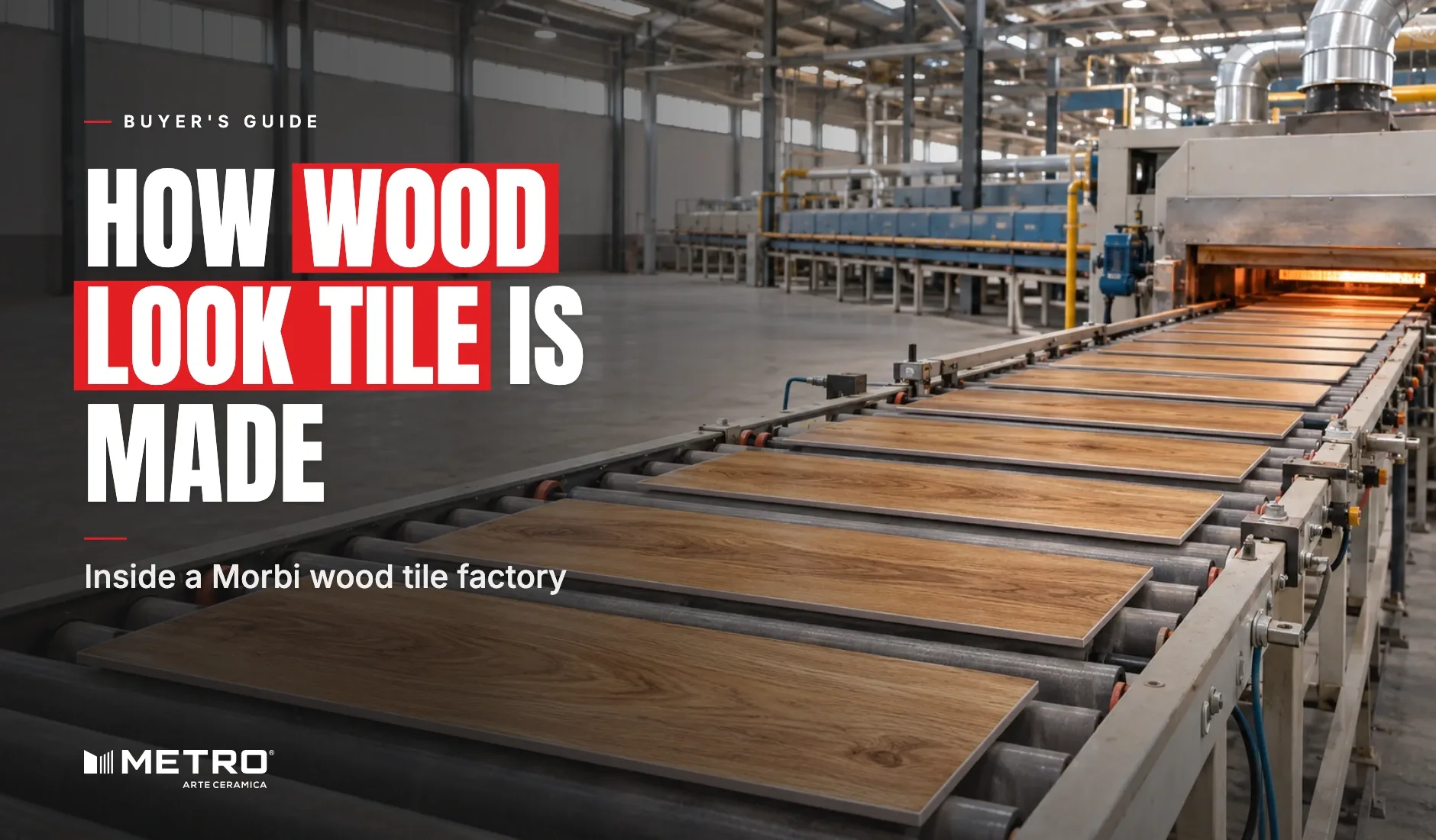
Pick up a wood look plank and the first questions are practical ones. Why does the grain look different on every tile in the box? Why is the edge rounded on ours and square on others? What is the tile made of? The answers sit on the factory floor, and dealers and importers usually ask for them before they ask about anything else.
Here is how wood look ceramic tile is made at our factory in Morbi, Gujarat, step by step, and what each step means for the floor you end up with.
Where the tile is made
Metro Wooden Tiles is made by Metro Ceramics in Morbi, the center of India's ceramic tile industry. The site covers 145,000 m² (about 1.56 million sq ft) and includes an Experience Center showroom where buyers see the designs laid as floors. The machinery named on our About page comes from Sacmi, LB, KEDA, System Ceramics, HLT and Nade.
We make one kind of product: glazed ceramic wood look tile. Plank formats, a chevron collection and the Diamante collection, all with a curve edge. No porcelain and no rectified tile. That focus shapes every step below.
Step 1: the body is pressed
The European standard EN 14411 classifies ceramic tiles by forming method, group A for extruded tile and group B for dry-pressed tile, and then by water absorption. Our tiles are dry-pressed glazed ceramic with 6 to 8% absorption, group BIIb.
The press packs the prepared body into a mold under high pressure. That one moment decides the shape, the thickness (9 to 9.5 mm on planks, about 3/8 inch) and, on our tiles, the edge.
Step 2: each plank gets its own mold
This is where rectified wood look tile and ours part ways.
A rectified plank is pressed as a larger tile and then cut down to size. Our catalog's example is a 20 x 120 cm plank sawn from a 60 x 120 cm tile. The cut leaves a sharp, square edge.
We press every plank to its finished size in its own mold. Our 200x1200mm catalog calls it an original mold tile. Because the edge is formed rather than cut, it comes out softly rounded, like the eased edge on a real board. Laid on a floor, the joint reads as the shadow line between two boards rather than a grid line. That curve edge is our main point of difference, and it is why we make nothing else.
The trade-off is honest. A formed edge varies very slightly in size from piece to piece, so our planks are laid with a joint of 3 to 5 mm (about 1/8 to 3/16 inch), not a hairline joint. If a design calls for a 1/16 inch joint, rectified tile is the right product.
Step 3: glazing and 3D digital printing
After pressing and drying, the tile is glazed and printed. The glaze is the layer that faces the room: water and dirt sit on it and wipe off.
The wood grain is applied by digital printing. Machinery makers such as System Ceramics describe their ceramic tile printing machines as high-definition digital decoration that can carry complex graphic effects and detailed textures. On our planks that means a 3D high-definition print with real grain relief on the textured surfaces, so the knots and grain lines are something you can feel as well as see.
Three surfaces come out of this stage:
- Matt Texture: low sheen with grain relief, the grip surface for bathrooms, stairs and outdoor floors.
- Satin Texture: a soft sheen over light relief, for living rooms and bedrooms.
- Satin Plain: smooth and low sheen, for dry rooms and walls.
Step 4: random faces, so the floor does not repeat
A printed design is not one image repeated on every tile. Each design has a set of different faces, so two neighboring planks rarely match. Installers add to that by mixing tiles from several boxes as they lay.
The count varies by design, from 1 to 18 on our planks. Madera Teak in 150x900mm has 18 faces. Oaklore Wallnut in 200x1400mm has 12. Ipe Out Nature in 200x1200mm, an outdoor decking look with ribbed relief, has 3. When you compare suppliers, ask for the face count of the exact design, not a figure for the whole range.
Step 5: firing
The printed tile goes through the kiln. Firing hardens the body and fuses the glaze and print into the surface. It also sets the strength: our planks have a breaking strength of 280 to 300 kg/cm², about 27.5 to 29.4 N/mm².
We do not publish a kiln temperature, and you should be wary of any supplier figure you cannot check.
Step 6: sorting, marking and packing
Fired tile is sorted before it is boxed, and two marks matter to your installer.
- Calibre code. Each box carries a code for its exact length band. On 200x1200mm, for example, the bands run from S (1207 to 1209 mm) to V (1215 to 1217 mm). One room should be laid from one calibre.
- Arrow on the back. Every plank has an arrow printed on its back. All arrows point the same way on the floor, which keeps the grain running in one direction.
Boxes are packed by size: 5 planks of 200x1200mm (8 x 48 in) cover 12.91 sq ft. For importers, a 20 ft container holds 26 pallets of 42 boxes, 1,092 boxes of 200x1200mm in all, about 28 tonnes. The tile ships under HS code 69072200, glazed ceramic floor tile.
What the factory does not make
No porcelain and no rectified planks, and a series is only made and laid in its own format, never cut down to another one. If your project needs porcelain or a 1/16 inch joint, say so early and we will tell you plainly that another product suits it better.
For dealers and importers
The plant holds CE, ISO 9001:2015 and ISO 14001, and Metro exports to more than 30 countries. Specs for every size are in the downloadable catalogs. Trade enquiries go through our export page. Want to see the tile first? Request samples and test them under your own lighting.
Planning a wood look tile floor?
Tell us the room and the size you have in mind. Our team replies within 24 to 48 hours, and we can post you a sample first so you can see the surface in your own light.
Frequently asked questions
What is wood look tile made of?
Ours is glazed ceramic: a dry-pressed body with 6 to 8% water absorption, covered by a fired glaze that carries the printed wood grain. It is not porcelain.
How do they get wood grain on tile?
By high-definition digital printing on the glazed tile before firing. Our textured surfaces add real grain relief, and firing fuses the print into the surface.
Why do wood look tiles have different patterns in the same box?
Each design has several different faces, from 1 to 18 on our planks, so neighboring planks rarely match. Mixing tiles from several boxes while laying helps further.
What is the difference between a curve edge and a rectified tile?
A rectified plank is cut down from a larger tile, which leaves a square edge. A curve edge plank is pressed to size in its own mold, so the edge comes out rounded.
Where is Metro wood look tile made?
At our factory in Morbi, Gujarat, India, the center of the Indian ceramic tile industry. The site includes an Experience Center showroom for buyers.
Is wood look tile made in India the same as porcelain?
Not ours. Our tile is glazed ceramic with 6 to 8% water absorption, group BIIb. Porcelain absorbs under 0.5%. Ask any supplier for the tested figure.