

06 August 2026 7 min read
Wooden Tiles for Exterior Walls: Why They Last Where Real Wood Won't
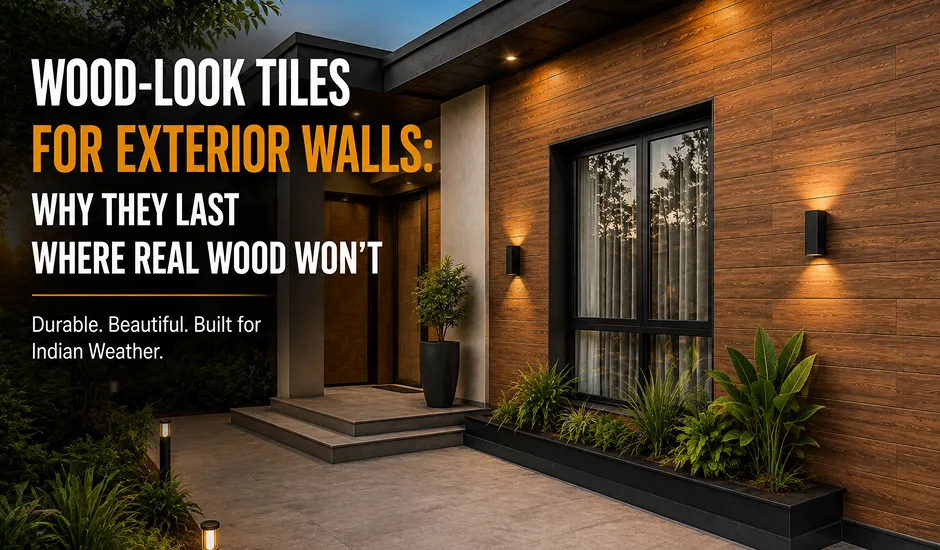
Exterior elevation is the first thing anyone notices about a home. In Indian residential design, wood-finish cladding on a facade has become one of the most requested finishes among architects and homeowners. But real wood on an exterior wall has to survive direct sun, months of monsoon spray, and constant dust in ways indoor flooring never does. Wooden tiles for exterior wall applications do a job here that real timber cladding simply cannot, and the difference shows up within the first monsoon season.
Why Real Wood Fails on Indian Exteriors
Timber cladding looks good in a showroom photo, but exposed to an Indian facade it runs into problems fast:
1. UV exposure
Direct sunlight bleaches and dries out timber cladding, causing surface cracking and colour fade within two to three years. South and west-facing walls take the worst of it.
2. Monsoon moisture
Repeated wetting and drying cycles cause real wood panels to swell, warp, and eventually pull away from their mounting battens. In coastal cities like Mumbai or Chennai, salt-laden air accelerates this further.
3. Termite and rot risk
Exterior wood sits in constant contact with humidity and soil-adjacent moisture. Both invite termite activity and fungal rot, sometimes within a single year of installation in high-humidity regions.
4. Maintenance load
Real wood cladding needs re-sealing or re-staining every one to two years to hold its colour and weatherproofing. Most homeowners underestimate this as a recurring cost when they first choose wood.
None of these are edge cases. They are the normal life cycle of real timber on an Indian exterior, and they are the reason wooden elevation tiles have replaced natural wood on most new residential facades.
What Makes Elevation Tiles Work Where Wood Does Not
Wood-look ceramic tiles are built for exactly this exposure, because they are fired, glazed surfaces rather than organic material. Metro's tiles, manufactured in Morbi, Gujarat, are designed with specific features that matter more on a facade than they do indoors.
1. Curve edge design for an authentic plank look
Metro's curve edge tiles are mould-formed rather than flat-cut. This replicates the rounded profile of a real timber plank instead of the flat rectified edge most tile brands produce. On an elevation, this detail is what makes the finish read as genuine wood cladding from the street, not as a printed tile. Rectified tiles, by contrast, tend to show micro-bending on large vertical surfaces over time, which breaks the visual line.
2. Low water absorption for monsoon exposure
Metro wood-look tiles carry a water absorption rate of 6 to 8%, which keeps the tile body stable through repeated monsoon wetting and dry-season heat cycles without swelling, cracking, or colour shift. For context, real timber absorbs moisture at several times that rate and has no built-in limit.
3. 3D print technology for grain detail at a distance
Elevation cladding is viewed from the street, often at an angle and from several metres away. Metro uses 3D high-definition printing, produced on Sacmi and KEDA machinery, to reproduce grain depth and knot detail with enough precision that the pattern reads as natural wood at that distance. Multiple random face patterns per design prevent the repeating-tile look that gives away cheaper printed tiles.
4. 9mm thickness for structural stability
At 9mm, the tile body resists the micro-flexing that thinner cladding materials suffer from wind load and temperature swings across a large wall face. This matters more on an elevation than it does indoors, where tiles sit flat on a stable substrate with no wind pressure.
Choosing a Size for Your Facade
The right plank size depends on how much unbroken wall area you are covering and what visual effect you want:
150x900mm and 200x1000mm planks
Best for large, uninterrupted wall sections where a long plank line adds visual height to a double-storey facade. These sizes also keep the grout line count manageable across a wide surface.
200x1200mm and 200x1400mm planks
Suited to feature panels and porch-facing walls where a wider, longer plank reduces visible grout lines even further. The 200x1400mm format is Metro's longest plank and reads closest to real timber boarding.
Works well as an accent band around a doorway or window frame rather than across a full facade. The angled V-pattern draws the eye to entry points without overwhelming the wall.
Browse the full range across all sizes in the downloadable product catalogue.
What to Check Before Buying Elevation Tiles
Not every wooden tile sold for floors works well on an exterior wall. Before placing an order for a facade project, verify these points:
1. Edge type
Confirm whether the tile is curve edge (mould-formed) or rectified (machine-cut flat). Curve edge planks sit more naturally on a vertical surface and resist the micro-bending that rectified tiles can develop over time on large facades.
2. Water absorption rate
Ask for the tested figure, not just a "low absorption" claim. For exterior wall use in Indian climates, 6 to 8% on ceramic bodies is the working range. Anything above 10% risks moisture damage across monsoon seasons.
3. Random pattern count
Check how many face patterns come per design. Fewer than three random patterns per tile will create a visible repeat on a large wall section, which defeats the purpose of a wood-look finish.
4. Thickness
9mm is the standard for tiles that need to handle wind load and thermal movement on a facade. Thinner tiles (6mm or 7mm) are built for interior floors and are not rated for vertical exterior use under sustained weather.
5. Certification
CE and ISO certification confirm the tile has passed standardised quality and dimensional testing. Metro carries both, and the certificates are available for verification on request.
Installation Notes Specific to Exteriors Walls
1. Exterior tiling is not the same job as an interior floor. Skipping these steps is the most common reason elevation tiling fails within a year: 2. Use exterior-grade, weatherproof tile adhesive rated for vertical facade application, not a standard interior fixing compound. 3. Maintain a full 2mm grout joint to allow for thermal expansion across a large, sun-facing wall. 4. Use a flexible, UV-stable grout formulation on any south or west-facing wall that receives direct afternoon sun. 5. Confirm the wall substrate is fully cured and free of dampness before starting. Trapped moisture behind an exterior tile has nowhere to escape and will push the tile off the adhesive over time.Bring Real Wood-Grain Character to Your Facade
A home's elevation carries the same design weight as its interior, without the option to replace materials every few years. Metro's curve edge, low-absorption wooden tiles give architects and homeowners a facade finish that holds its colour and shape through repeated monsoons, without the upkeep real timber cladding demands.
Compare formats across the full Chevron and Diamante collections, or contact Metro for elevation-specific guidance on your project
Frequently Asked Questions
1. Are wood-look tiles suitable for exterior walls in India?
Yes. Ceramic wood-look tiles with a water absorption rate of 6 to 8% and a glazed surface are built to handle direct sun, monsoon rain, and dust without the recurring maintenance of real wood needs. They do not swell, warp, or attract termites the way timber cladding does.
2. Do elevation tiles fade in direct sunlight?
A properly glazed, kiln-fired wood-look tile does not fade the way real wood or painted cladding does. The colour is fired into the surface during manufacturing, not applied as a stain or coating that sits on top.
3. What size tile works best for a house facade?
Larger formats like 200x1200mm or 200x1400mm reduce the number of grout lines across a wide wall and read better from street distance. For accent detail around doors or windows, the 80x450mm chevron format works well without covering the full wall.
4. Do exterior wood-look tiles need special adhesive?
Yes. Vertical exterior application needs a weatherproof, exterior-grade tile adhesive and UV-stable grout, not the standard adhesive used for interior floors. Using interior-grade adhesive on a facade is the most common reason tiles debond within the first year.
5. How do curve edge tiles differ from rectified tiles on a facade?
Curve edge tiles are mould-formed with a rounded plank profile that mimics real timber. Rectified tiles are machine-cut to a flat, sharp edge. On a large vertical surface, rectified tiles are more prone to micro-bending over time, which breaks the visual line and can cause lippage between adjacent tiles.