

18 October 2026 7 min read
Ceramic or porcelain timber look tiles: what the difference means
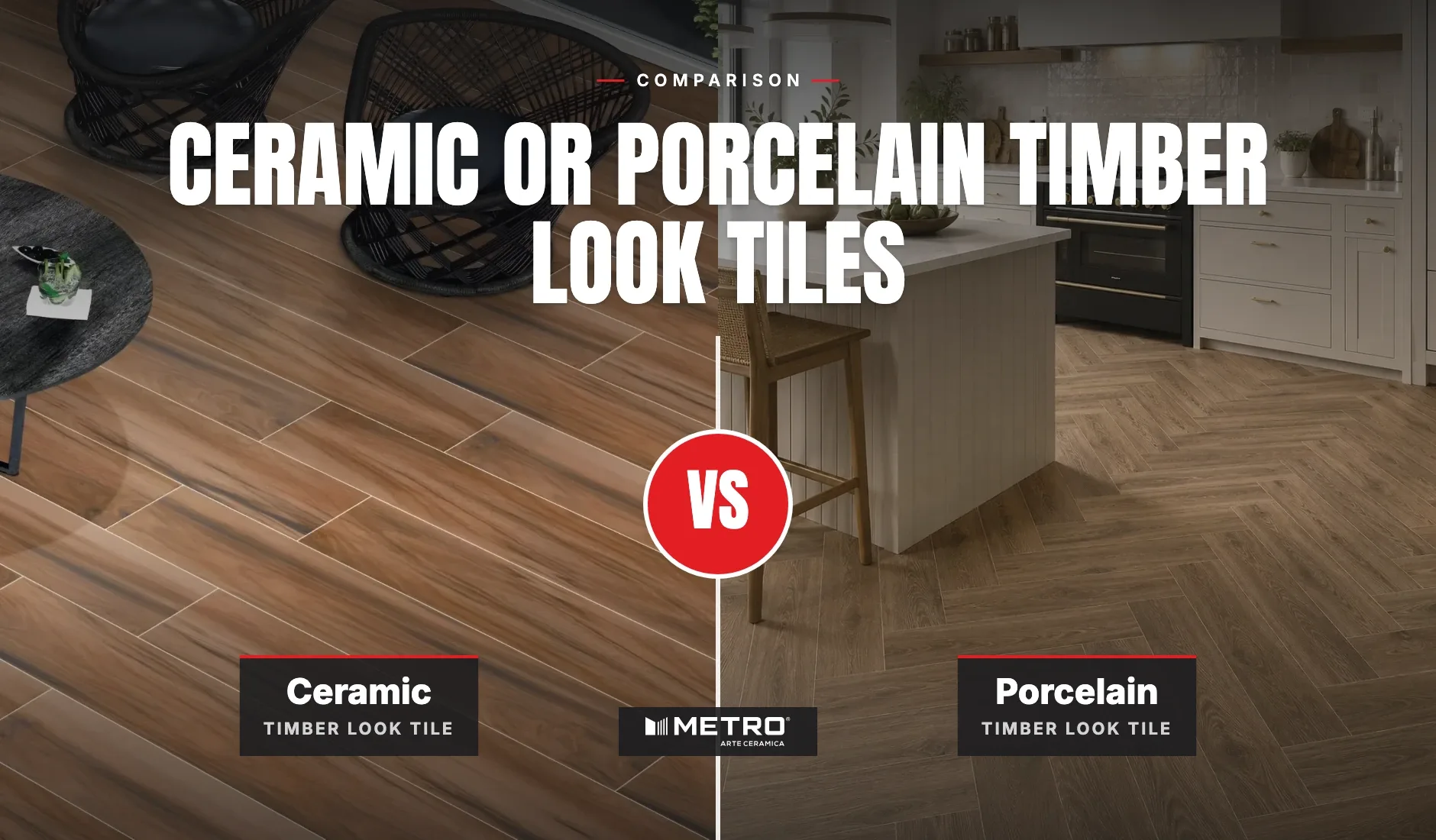
Walk through a tile showroom in Australia and nearly everything in the timber look range gets called porcelain. Some of it is. Plenty of it is glazed ceramic, sold under the word that sounds more expensive.
The difference is real, it is measurable, and it matters in some rooms and not in others. We make glazed ceramic timber look tiles, so you know where we sit. The numbers are below anyway, because you can get them from any supplier worth dealing with.
The difference is one measured number
Porcelain is not a style or a grade. It is a classification based on how much water the fired body takes up.
In Australia the classifying standard is AS 13006:2020, which adopts ISO 13006 and sets out the definitions, classification and marking for ceramic tiles. Porcelain sits in the lowest absorption group, under 0.5%.
Our tiles are glazed ceramic and absorb 6 to 8%, which is group BIIb under EN 14411, the European standard our factory certifies to. That is the normal range for glazed ceramic, and it is a long way from 0.5%.
We are not going to call that gap small. What matters is knowing what the figure describes.
What the figure actually describes
The absorption number measures the body of the tile, the fired clay underneath. It says nothing about the glaze on top.
On a glazed floor, the glaze is the only part that meets water, a mop, a wet towel or a dog. The body is sealed under it and sits on adhesive. Where the body does come into play is at a cut edge, a drilled hole, or an unglazed tile, and on a finished floor those edges sit under grout or behind skirting.
So the honest summary is this: on a glazed timber look floor, the absorption figure tells you less about day to day performance than the surface and the edge do.
Where it does change the decision
A specification that names porcelain. If an architect, a builder or a strata has written porcelain into the documents, or requires a slip rating with a test report, our tile does not meet a specification written around those numbers. We do not publish slip ratings and we are not going to invent one. Telling you that up front costs us a sale now and then.
Unglazed or through-body applications. If the design calls for an unglazed finish, the body is the surface and the figure becomes the whole story. We only make glazed tiles.
Anywhere you want a minimal grout joint. This is about the edge rather than the body, but it comes up in the same conversation. Every tile we make is calibrated with a formed curve edge, which needs a 3 to 5 mm joint. A narrow joint needs rectified tile.
Where it does not change the decision
Alfresco and outdoor floors. Every design we make is approved for outdoor floors: covered and open alfresco areas, verandahs, pergolas, pool surrounds and patios. That includes the cooler parts of Victoria, Tasmania, the ACT and the NSW tablelands. For any outdoor floor use the Matt Texture surface, because the grain relief is what gives grip underfoot when it is wet.
One point of precision there. Our website publishes no frost test result, so we do not use rating words about frost. The product is approved for outdoor floors; the certificate for a frost figure is not something we publish, and if a project needs one, say so in the enquiry.
Bathrooms, ensuites and laundries. Glaze and waterproofing do the work here, not the body. Tile and grout are water resistant, not waterproof, and in a wet area the waterproofing goes under the tile. That is equally true of a porcelain tile at 0.3%.
Pool surrounds. Grip and drainage decide this, which means the matt surface and the fall of the substrate.
What to ask for, in writing
- The absorption figure and the standard it was tested to. Not "low absorption", which is not a number.
- The edge type. Calibrated with a formed edge, or rectified.
- The number of randomised faces for the exact design, which runs from 1 to 18 across our plank range. On a large open-plan floor a low count shows as a repeat.
- Thickness and strength. Ours are 9 to 9.5 mm with a breaking strength of 27 to 29 N/mm².
- Batch and calibre availability for the full quantity, so one area is laid from one batch.
- Certification. We hold CE, ISO 9001:2015 and ISO 14001. A certificate can be checked; a claim cannot.
Full specifications for each format are in the downloadable catalogues.
Choosing a size
- 150x900mm: the narrowest plank and the closest to a sawn board. 8 tiles per box, 1.08 m², 22 kg.
- 200x1200mm: the widest choice of matt designs and fewer joints across an open-plan floor. 5 tiles per box, 1.20 m², 25 kg.
- 200x1400mm: the longest plank, for large living areas and covered alfresco runs. 4 tiles per box, 1.12 m², 24 kg.
A long plank suits a big floor and works against you in a small one, where most planks end up cut at the walls. Every design is on the all designs page.
Two designs worth seeing as a sample are NR-142008 (12 randomised faces) and NR-142009 (12 randomised faces), both 200x1400mm in Satin Texture.
The short version
If your documents say porcelain, buy porcelain. If they do not, the absorption figure matters less than the surface you pick for the room and the edge you pick for the look, and that is where a formed curve edge earns its place. For a full picture of timber look tiles in Australian homes, read the complete guide, and for outdoor areas specifically, the alfresco guide.
Send through the format and the area you need and you will get a rate back. Get in touch to see samples in person.
Frequently asked questions
Are porcelain timber look tiles better than ceramic?
They are different rather than better. Porcelain absorbs under 0.5% and glazed ceramic more, which describes the body rather than the glazed surface you walk on. Where a specification names porcelain, buy porcelain.
What is the water absorption of your timber look tiles?
6 to 8%, which is group BIIb under EN 14411. That figure describes the fired body under the glaze. Ask any supplier for the tested number and the standard behind it.
Can glazed ceramic timber look tiles go outside?
Yes. Every design we make is approved for outdoor floors, including open alfresco areas, verandahs and pool surrounds, and the Matt Texture surface is the one to use outside for grip.
Are they suitable for a bathroom or ensuite?
Yes, with the matt surface on the floor and the waterproofing done underneath. Tile and grout resist water but are not a waterproof layer, whatever the absorption figure says.
Do you publish a slip rating?
No. We point to Matt Texture because the grain relief gives grip, but we do not publish a rating. If your project needs a figure with a test report, tell us in the enquiry.
Why do your tiles need a wider grout joint?
Because the edge is formed in the mould rather than sawn, which is what makes the joint read as the shadow between two boards. That edge needs a 3 to 5 mm joint. A minimal joint needs rectified tile, which we do not make.