

17 October 2026 7 min read
Wooden tiles for bathrooms: grip, grout and waterproofing
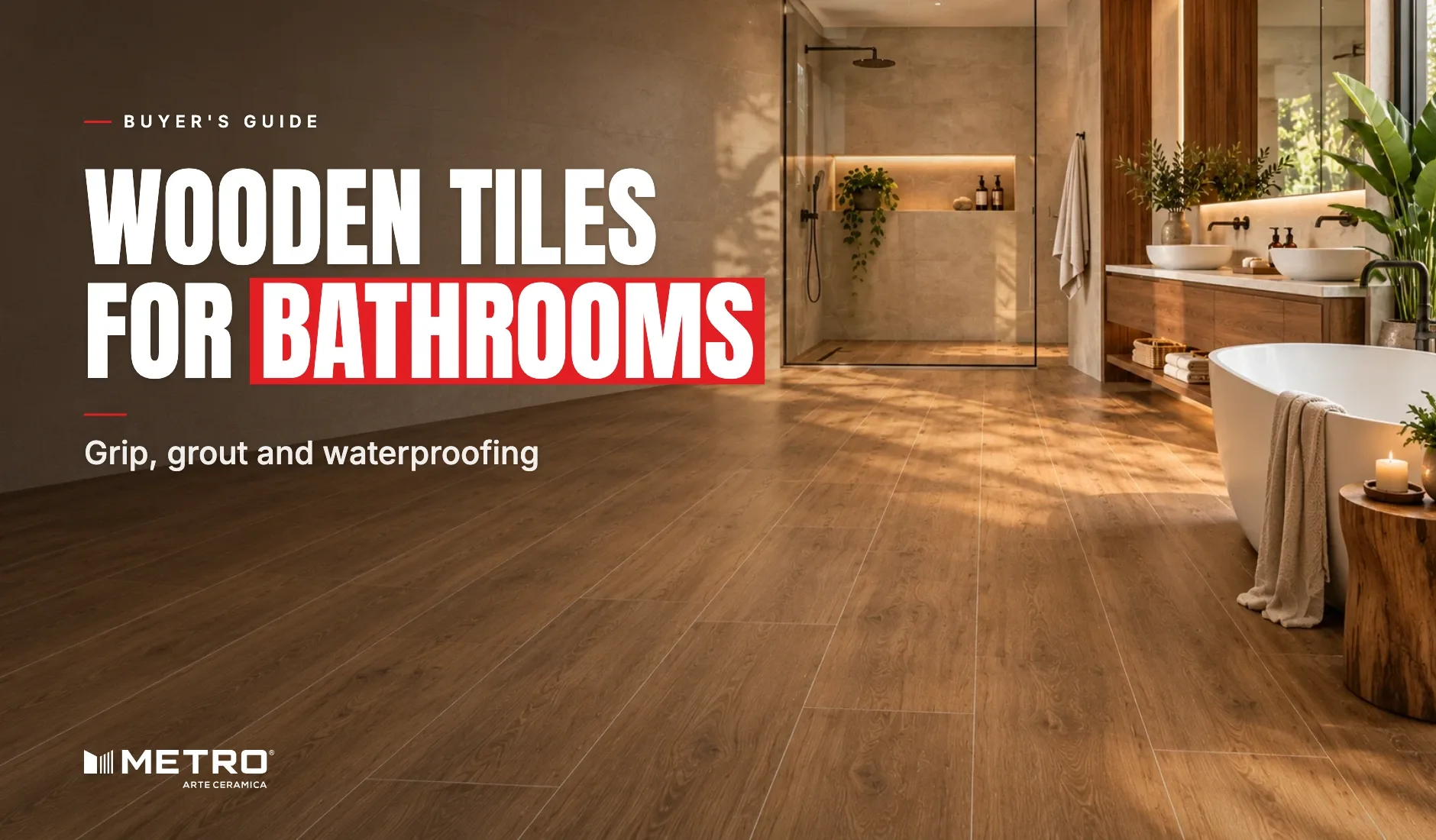
An Indian bathroom is wet all over, not just inside a shower cubicle. A bucket and mug, a floor trap in the corner, and water across the whole floor twice a day. That is a harder brief than most bathroom flooring is written for, and it is the reason real wood never gets considered here in the first place.
Wooden tiles give the same warm grain without that problem, as long as two things are right: the surface you pick, and the waterproofing underneath. This guide covers both, plus the format that suits a typical flat bathroom.
What an Indian bathroom does to a floor
It stays wet. Water sits on the floor for long stretches every day, and the slope to the trap decides how long. A floor that drains slowly stays wet for hours.
The water is often hard. In much of the country, hard water leaves scale on anything it dries on. On a textured surface it shows sooner than on a smooth one, and it comes off with routine cleaning rather than scrubbing.
Cleaning is aggressive. Household staff and most owners use strong cleaners and a hard brush. A finish that needs gentle care will not survive the actual cleaning routine.
Fittings get dropped. A steel bucket landing edge first on a tile floor is a real event, not a hypothetical one.
What makes a tile suitable for a bathroom
The surface decides the grip. For bathroom floors we point to Matt Texture: a low sheen surface with grain relief you can feel underfoot. That relief is what gives grip on a wet floor. 71 designs carry it, 41 of them in 200x1200mm. Satin Plain is smooth and belongs on a wall or in a dry room, not on a bathroom floor.
The body is glazed ceramic. It absorbs 6 to 8% of its weight in water, which is group BIIb under EN 14411. The Indian Standard for pressed ceramic tiles, IS 15622, covers glazed pressed tiles for floors and walls.
That absorption figure is worth understanding rather than comparing blind. It describes the fired body under the glaze. The water in a bathroom meets the glaze first, and the glaze does not let it through. Vitrified tiles absorb under 0.5%, which is a real difference in the body and almost none on the surface you actually mop.
The edge is moulded, not cut. Every tile we make has a curve edge formed in the mould rather than sawn from a larger tile. The joint then reads as the shadow line between two boards. Most tile buyers never think about edges until they see two floors side by side.
It is 9 to 9.5 mm thick, with a breaking strength of 280 to 300 kg/cm².
The part most bathroom floors get wrong
Tiles and grout are water resistant. They are not waterproof, and no tile at any absorption figure makes a bathroom waterproof.
The waterproofing is a separate layer that goes under the tile, across the floor and up the walls to the height your contractor specifies. If that layer is missing or badly lapped at the corners, water travels through the grout into the slab and appears on the ceiling of the flat below. This is the single most common reason a bathroom gets opened up again two years later, and it has nothing to do with which tile was chosen.
Ask your contractor to show you the waterproofing before the tiling starts. Once the tiles are down, you cannot see it.
Choosing a format
- 150x900mm: the usual choice for a flat bathroom. The narrow plank means fewer awkward cuts around the trap, the WC and the door. 8 tiles a box, 11.62 sq ft.
- 200x1200mm: for a larger bathroom, and the size with the widest choice of matt designs. 5 tiles a box, 12.91 sq ft.
In a small bathroom a long plank works against you, because most of the planks end up cut at the walls. Every design is on the all designs page, and the matt ones are the shortlist for a floor.
For a floor that gets wet, two Matt Texture designs to start with are Oaklore Wallnut (12 random faces) and D26-27565, both 200x1200mm.
Where this is not the right product
If the specification asks for a slip rating. We do not publish a slip rating for our designs, so a project that needs a stated figure for the exact tile should ask us for the test rather than rely on the catalogue. If a number has to appear in a tender document, say so in the enquiry.
If you want a joint narrower than 3 mm. The curve edge needs a 3 to 5 mm joint. Rectified tile is the product for a minimal joint, and we do not make it. The difference between the two is covered in rectified vs non-rectified tiles.
On the wall of a shower with no waterproofing behind it. That is not a tile problem, but it is the one that gets blamed on the tile.
Laying notes for a bathroom
- Waterproof first, floor and walls, and let it cure as specified before tiling.
- Get the slope right to the trap. The fall is set in the bed, not corrected with adhesive.
- Joints of 3 to 5 mm, with spacers of at least 3 mm.
- Offset each row by a quarter plank: 225 mm on 150x900mm, 300 mm on 200x1200mm. Our laying catalogue rules out the half offset.
- Keep the back arrows one way, and use a single calibre code for the room.
- Let the bed cure three to four days before grouting, then fill the joints evenly.
The short version
For a bathroom, pick Matt Texture and then argue about colour. Get the waterproofing and the slope confirmed before the first tile is laid, because those two decide whether the floor is still sound in five years. Metro is India's No. 1 brand specialised in wooden tiles, and every tile we make has a curve edge.
Request a free sample and stand on it wet before you commit. Specifications are in the catalogue downloads, and you can contact our team for a rate for your area.
Frequently asked questions
Are wooden tiles good for bathrooms?
Yes, with the matt surface on the floor and proper waterproofing underneath. The grain relief in Matt Texture is what gives grip when the floor is wet, which is the main thing a bathroom floor has to do.
Which surface should I choose for a bathroom floor?
Matt Texture. It has a low sheen and a relief you can feel, so it holds underfoot on a wet floor. Satin Plain is smooth and is meant for walls and dry rooms.
What is the water absorption of wooden tiles?
Ours absorb 6 to 8% of their weight, group BIIb. That figure describes the body under the glaze, not the glazed surface. Ask any supplier for the tested value and the group it falls in.
Do wooden tiles make a bathroom waterproof?
No. Tiles and grout resist water but are not a waterproof layer. The waterproofing is a separate membrane under the tile, and it is the part that keeps water out of the slab.
Which size suits a small bathroom?
150x900mm in most flats. A long plank in a small bathroom means more cuts at the walls and around the trap, which looks busier and wastes more material.
Can the same tiles go on the bathroom wall?
Yes, our plank formats are specified for floors and walls. On a wall they are fixed with adhesive rather than a mortar bed, and the waterproofing still goes behind them.