

18 August 2026 7 min read
Outdoor Wood-Look Tile: Where Ceramic Plank Works, and Where It Doesn't
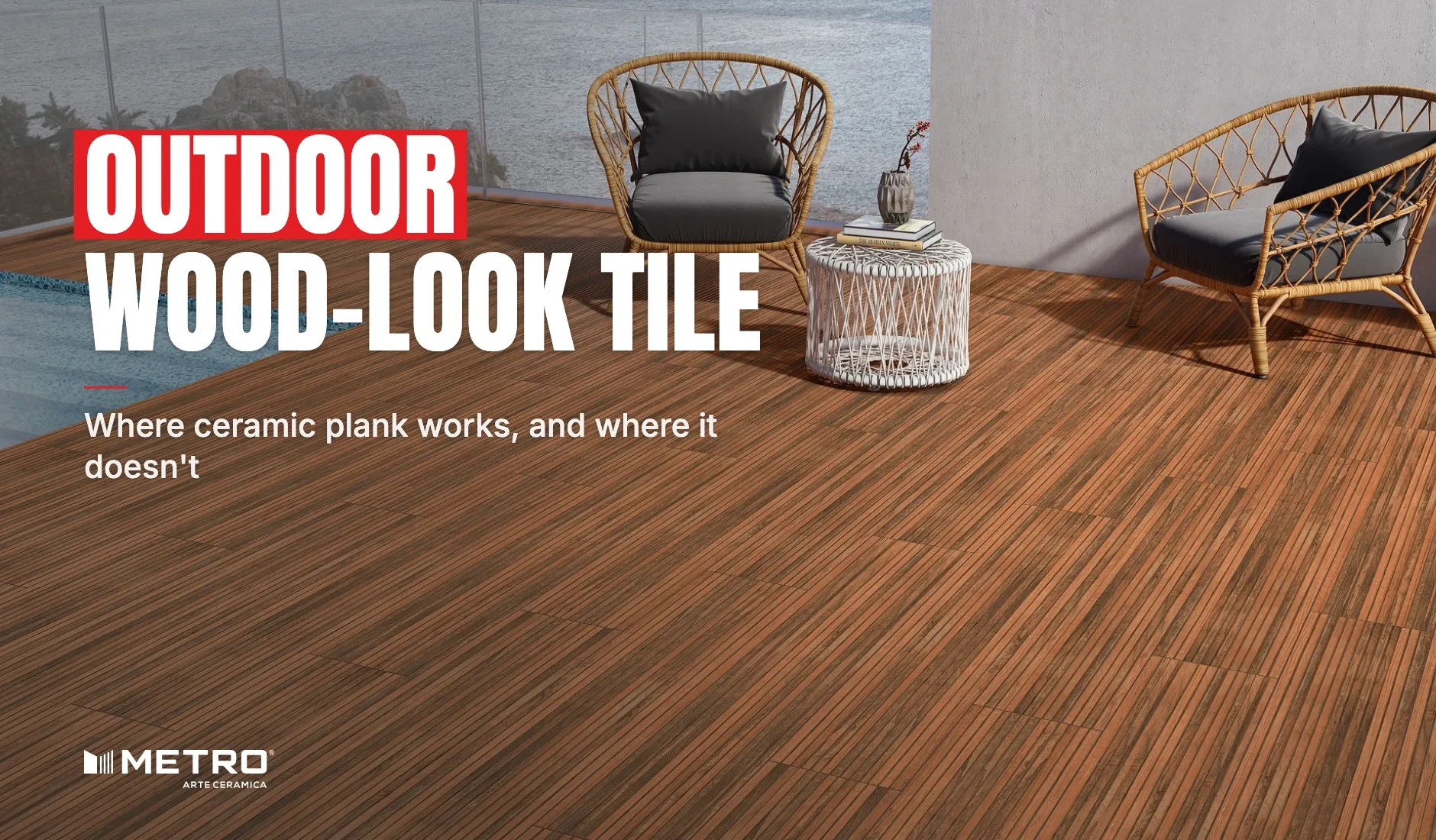
A wood deck looks great for a season or two, then the maintenance starts: sanding, staining, replacing boards that have rotted where water pools. Wood-look tile solves that, giving a porch or patio the same warm plank look without the seasonal upkeep.
But not every wood-look tile belongs outdoors, and the honest version of this advice starts with a limit rather than a sales pitch. Where you live determines what you can install.
The climate question comes first
Outdoor tile fails for one main reason: water gets into the tile body, freezes, expands, and cracks it from the inside. This is freeze-thaw damage, and it is why exterior tile in cold climates has to be specified on water absorption above everything else.
Metro's tiles are ceramic, with a tested water absorption rate of 6 to 8%. That is a durable, stable body for the applications below, and it is not the right product for an exposed, ground-level patio in a climate with freezing winters. If you are in Minnesota, Colorado, upstate New York, or anywhere that goes below freezing for stretches of the season, an exposed patio needs a tile rated specifically for frost exposure, which means a much lower absorption figure than ceramic offers.
Telling you that up front costs us a sale in half the country. It also means the recommendation below is one you can actually trust.
Where ceramic plank tile works outdoors
Covered porches and screened patios
A roof changes everything. Under cover, the tile is not sitting in standing rainwater or accumulating ice, and the freeze-thaw mechanism largely stops being a factor. Covered porches, screened-in patios, breezeways, and carport floors are all sound applications for ceramic plank tile in most of the country.
Warm-climate patios and pool surrounds
In Florida, the Gulf Coast, South Texas, Arizona, and Southern California, freeze-thaw is not part of the picture. Exposed patios, pool decks, and outdoor kitchens work well in these states, where the real enemies are UV exposure and heat rather than ice.
Sunrooms and three-season rooms
Enclosed but unconditioned spaces see wide temperature swings without direct precipitation. Ceramic plank handles this comfortably, and it reads better than vinyl or laminate in a room with a lot of natural light.
Exterior wall cladding and facade accents
Vertical surfaces shed water instead of holding it, which removes the pooling problem entirely. Wood-look plank on an exterior wall, a porch ceiling, or a facade accent panel is a strong application in almost any climate.
Why wood-look tile beats real decking in these spaces
No refinishing schedule
Real decking needs sanding and resealing every one to two years to hold color and water resistance. Tile needs sweeping.
No rot at contact points
Any spot where a deck board stays damp becomes a starting point for rot that spreads along the board. Ceramic has no organic material to rot.
No splintering
As wood ages and dries, it splinters, which matters on a porch or pool deck where people walk barefoot.
UV-stable color
The wood grain on a glazed, kiln-fired tile is fired into the surface, not stained onto it. Direct sun does not bleach it the way it bleaches decking or painted cladding.
No termite exposure
Ceramic gives termites nothing to target, which matters in the Southeast and Gulf states where pressure is constant.
What makes a plank read as real wood outdoors
Curve edge profile
Metro's curve edge tiles are mould-formed rather than machine-cut flat, reproducing the rounded profile of a real timber plank. Rectified tiles produce a sharp squared edge and are more prone to bending across long formats. On a wide porch floor, that bending shows up as lippage between planks, which is the point where a wood-look floor stops looking like wood.
Multiple random face patterns
Each design carries several random face patterns, so the grain does not repeat every few tiles. On a large patio viewed all at once, a visible repeat is the fastest giveaway of a low-cost tile.
3D high-definition printing
The grain and knot detail is reproduced at a resolution that holds up close, which matters on a porch where people sit rather than pass through.
9mm thickness
At 9mm (about 3/8 inch), the body resists flexing across long plank formats and handles concentrated loads from furniture legs and foot traffic.
Choosing a size for a porch or patio
150x900mm (6" x 36") and 200x1000mm (8" x 40")
Work well for standard porches and covered decks, giving a long plank line without excessive cutting around the perimeter.
200x1200mm (8" x 48") and 200x1400mm (8" x 55")
Suit larger open patio areas where fewer grout lines read as a more continuous outdoor floor.
80x450mm Chevron (3" x 18")
Better as a porch entry accent or a small patterned section than a full patio, since angled joints add complexity to drainage slope.
Full specs across every format are in the downloadable catalog.
What to confirm before ordering
Your climate
If the space is uncovered and your winters freeze, ask specifically about frost-rated options rather than assuming any outdoor tile will do.
Water absorption
Ask for the tested figure. Metro's is 6 to 8%. Any supplier who won't give you a number is worth a second look.
Slip resistance
For pool surrounds and any surface that gets wet, confirm the finish is matte or textured with a documented slip rating. Never use a polished finish outdoors.
Edge type
Curve edge or rectified. Curve edge lays flatter across long formats.
Certification
Metro carries CE and ISO certification, manufactured in Morbi, Gujarat, and supplies more than 30 countries.
Installation notes for exterior use
- Confirm proper slope for drainage before tiling. Standing water shortens the life of any outdoor tile installation regardless of the tile's rating.
- Use an exterior-grade thin-set adhesive rated for your climate, not an interior mortar mix.
- Maintain a full grout joint for thermal movement. An outdoor surface sees a wider temperature swing in a single day than an indoor floor sees all year.
- On raised patios and pool decks, use a breathable substrate or pedestal system so trapped moisture has somewhere to go.
Get the wood look without the deck maintenance
An outdoor space deserves the same warmth as the rest of the house, without an annual sanding and resealing schedule. The right choice depends on whether the space is covered, what your winters do, and how the surface actually gets used.
If a bathroom or shower renovation is also on the list, see our guide to wood-look tile for bathrooms, or contact us and tell us your location and whether the space is covered. We'll tell you honestly whether our product fits.
Frequently asked questions
Can wood-look tile be installed outdoors?
Yes, in the right conditions. Covered porches, screened patios, sunrooms, exterior wall cladding, and warm-climate patios are all sound applications. Exposed patios in freezing climates need a tile specified for frost exposure, which ceramic at 6 to 8% absorption is not.
Will outdoor wood-look tile fade in the sun?
No. The grain pattern is fired into a glazed surface rather than stained onto wood, so it holds its color through continuous direct sun in a way timber decking cannot.
Is wood-look tile slippery when wet?
A matte or textured finish with a documented slip rating is not. A polished or glossy finish should never be used on a patio, porch, or pool deck no matter how it looks dry.
What size tile works best for a patio?
200x1200mm (8" x 48") or 200x1400mm (8" x 55") reduce grout lines across an open patio. For a standard porch, 150x900mm (6" x 36") fits with less cutting at the edges.
What is the difference between curve edge and rectified tile outdoors?
Curve edge tiles are mould-formed with a rounded plank profile that mimics real wood. Rectified tiles are cut flat and square, and are more prone to bending across long formats, which produces lippage between planks on a large outdoor surface.