

23 July 2026 7 min read
Wood-Look Tile in Bathrooms & Wet Areas: What Actually Holds Up
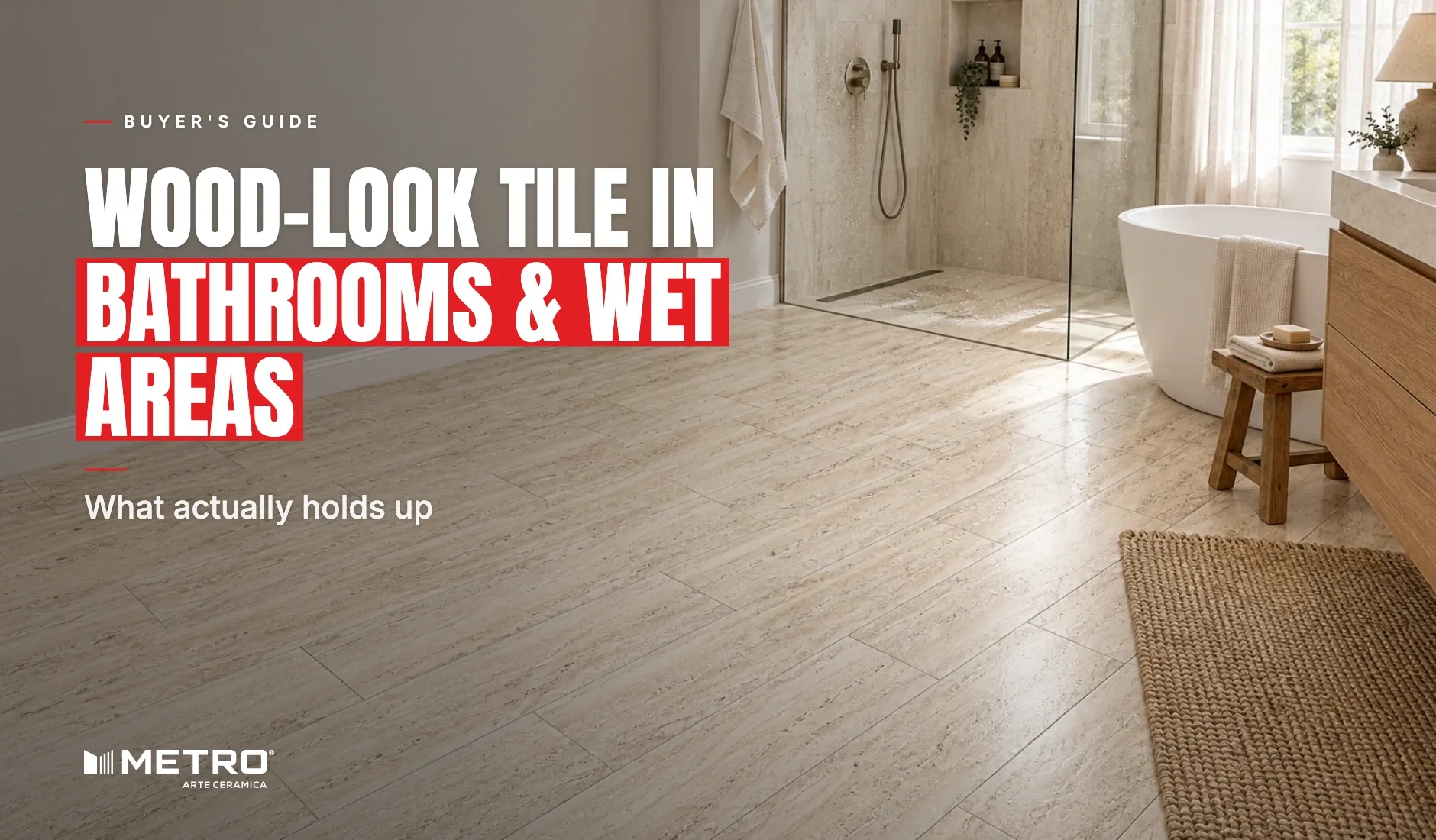
Wood-look tile is one of the few ways to bring the look of hardwood into a bathroom without the swelling, cupping and mold that real wood and laminate suffer when they stay damp. But "wood-look tile" covers several different products, and the one you pick, and how it is installed, decides whether a bathroom floor lasts.
This guide covers what Metro's tile is made of, where it works in a bathroom, where a different product or layout is the better call, and how to install it so water stays out.
Why wood, laminate and vinyl struggle in wet rooms
- Hardwood: wood takes on moisture from the air and gives it back. In a bathroom that cycle makes boards swell, cup and gap, and standing water around a tub or toilet can rot the subfloor.
- Laminate: the core is high-density fiberboard. Once water gets into a joint, the core swells at the edges and the damage is permanent.
- Vinyl plank: the plank itself is waterproof, but water that gets under a floating floor has nowhere to go, which is where mold and adhesive failures start.
What Metro wood-look tile is made of
Metro makes glazed ceramic plank tile in Morbi, India. The tile body has a tested water absorption of 6 to 8%, and the face is sealed by a fired glaze that carries the printed wood grain. Each plank is 9 to 9.5 mm thick, about 3/8 inch.
The glaze is what faces the room. Water on the surface sits on the glaze and wipes off; it does not soak into the face the way it soaks into wood. The body underneath is more absorbent than porcelain, which is why the installation steps below matter: on a floor that is properly waterproofed and grouted, the tile body is not what the water reaches.
Metro's planks come in four US sizes: 6 x 36 inch, 8 x 40 inch, 8 x 48 inch and 8 x 56 inch.
Ceramic or porcelain for a bathroom?
Porcelain is fired denser and absorbs under 0.5% water. It is the product to specify where tile is exposed to freezing weather outdoors, and many designers choose it for shower floors that stay wet for long stretches.
Glazed ceramic is the everyday choice for bathroom floors and walls, where water lands on the surface and is wiped or dried off. In most bathrooms the choice between the two matters less than the finish you pick and the waterproofing under the tile. We compare them in more detail in tile that looks like wood: the honest pros and cons.
Where wood-look plank works in a bathroom
Bathroom floors
This is the main use. Choose a design with Metro's Matt Texture finish for any floor that gets wet, because it gives more grip underfoot than the satin finishes. Keep satin finishes for walls and dry rooms.
Shower walls and tub surrounds
Walls take splashes, not standing water, and carry no foot traffic, so any finish works. Running planks vertically makes a low ceiling or a narrow shower feel taller. A tone-matched grout keeps the plank lines soft; a contrasting grout picks out each board.
Shower floors
A shower floor has to slope to the drain, usually about 1/4 inch per foot. Long planks cannot follow a slope that falls in more than one direction, so a center drain with a four-way slope is a poor match for 36 inch or longer tile. If you want planks on a shower floor, plan a linear drain along one wall so the floor falls in one direction, use a Matt Texture design, and waterproof the whole pan. Otherwise, use a small mosaic on the shower floor and the wood-look plank on the walls and the rest of the bathroom.
Laundry rooms and mudrooms
Both see wet shoes, spills and the odd leak. A textured plank handles all three and mops clean.
How to install it so water stays out
- Waterproof first. Tile and grout are water resistant, not waterproof. In showers and around tubs, a waterproofing membrane under the tile is what keeps water out of the wall and subfloor.
- Prepare a flat substrate. Long planks show any dip or hump. The floor should be flat, clean, dry and fully cured before tiling.
- Use the right thin-set. A polymer-modified mortar meeting ANSI A118.4 or A118.15 gives a strong bond in damp rooms. Back-butter each plank so there are no hollow spots.
- Keep a 3 to 5 mm joint. Metro's planks have a curve edge, not a rectified one, so they are laid with a joint of 3 to 5 mm, about 1/8 to 3/16 inch. The joint follows the small natural variation along each plank and reads like the gap between real boards.
- Pick the grout for the room. Epoxy or urethane grout resists staining and water well in showers. If you use cement grout, seal it and reseal it as the grout maker advises.
- Leave movement joints. Leave a gap at the walls and at changes of plane, filled with a flexible sealant, so the floor can move with the building.
- Ventilate. An exhaust fan sized for the room keeps grout lines and ceilings dry.
Slip resistance
A wet floor is the main safety risk in any bathroom. Put textured or matte finishes on floors, keep glossy and smooth finishes for walls, and make sure a shower floor drains so water does not pool. For a floor that will be wet most of the time, ask for the slip rating of the exact tile you are considering.
Care and upkeep
Sweep, then damp-mop with a pH-neutral cleaner. The glazed face needs no oiling, sanding, waxing or refinishing. The part that needs attention over the years is the grout: seal cement grout in wet areas and reseal it when water stops beading on it.
For a floor that gets wet, two Matt Texture designs to start with are Oaklore Bianco and Oaklore Cemento, both 200x1000mm (8 x 40 in).
The short version
Wood-look ceramic plank gives a bathroom the look of wood without the upkeep, as long as you use a textured finish on floors, waterproof the wet zones and keep the plank for the surfaces it suits. If you are planning a bathroom and want help choosing a size or finish, talk to our team. Heating the floor too? Read can you install wood-look tile over underfloor heating.
Frequently asked questions
Can wood-look tile go on a bathroom floor?
Yes. It is one of the uses it suits best. Choose a textured or matte finish for grip, and have it laid on a flat, properly prepared floor with a 3 to 5 mm joint.
Is wood-look tile waterproof?
The glazed face does not let water soak in, but no tile floor is waterproof on its own, because water can get through grout joints. In showers and around tubs, a waterproofing membrane under the tile does that job.
Can I use wood-look plank on a shower floor?
Yes, with a linear drain so the floor slopes in one direction, a Matt Texture finish and a fully waterproofed pan. With a center drain, use a small mosaic on the shower floor and plank on the walls.
Are wood-look tiles slippery when wet?
Glossy and smooth finishes can be. Textured and matte finishes give more grip, which is why they are the right choice for bathroom floors.
What is Metro wood-look tile made of?
Glazed ceramic, 9 to 9.5 mm thick, with a tested water absorption of 6 to 8% and a curve edge. It is made in Morbi, India, and carries CE and ISO certification.
How do I clean wood-look tile in a bathroom?
Sweep and damp-mop with a pH-neutral cleaner. The tile needs no sanding or refinishing. Seal cement grout in wet areas and reseal it from time to time.