

11 August 2026 8 min read
Wooden Tiles for Staircases: Getting the Safety, Grip, and Edge Detail Right
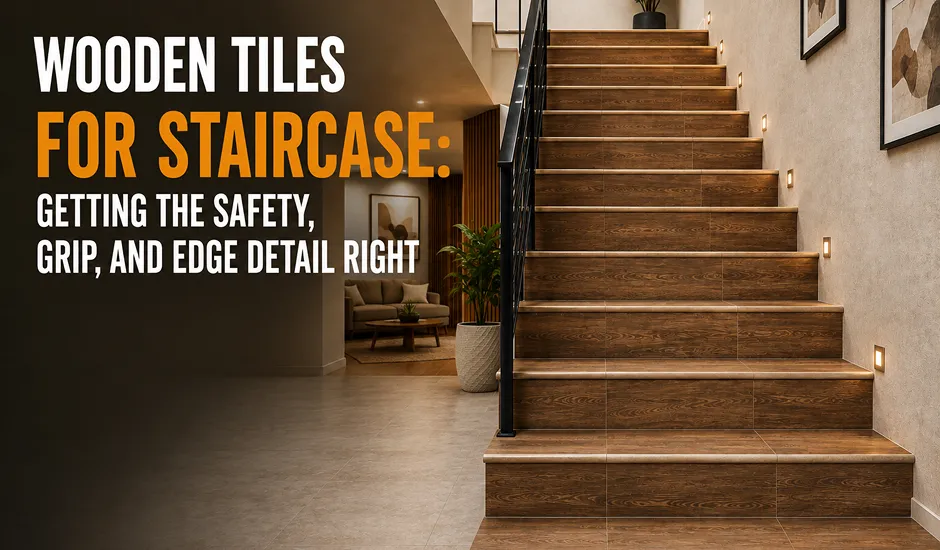
Staircases take more direct wear than almost any other surface in a home, and they carry a safety risk a flat floor does not. A wood-look finish on stairs is one of the most requested staircase tiles design choices in Indian homes right now, but choosing wooden tiles for a staircase is not the same decision as choosing tiles for a living room floor. The finish, edge profile, grip rating, and tile thickness all matter more here than the pattern itself.
Why real wood struggles on stairs
Timber stair treads are a classic look, but they come with problems that show up fastest on the step with the heaviest daily traffic:
Wear concentration
The front edge of every tread takes the most footfall. Real wood shows scuffing, dulling, and finish wear at that edge years before the rest of the staircase catches up. In a household with children or elderly family members, this wear also reduces grip exactly where it matters most.
Moisture from footwear
Wet shoes, mopping water, or a nearby entrance door introduce moisture directly onto tread surfaces. This is exactly the condition real wood handles worst, and on stairs, a slick wet surface is a fall hazard, not just a maintenance problem.
Refinishing disruption
Sanding and resealing a wooden staircase means the stairs are unusable for days. In a two-storey Indian home with a single staircase, that is far more disruptive than refinishing a flat floor in a room you can walk around.
What a wood-look tile staircase needs
A staircase is not a floor laid vertically in steps. It has its own requirements that a standard floor installation guide will not cover.
Slip resistance comes before pattern
The single most important spec on a stair tile is its anti-skid rating. A glossy, polished wood-look finish that looks good on a living room floor becomes a real fall risk on a stair tread, especially when wet. Always choose a matte or textured finish rated for anti-skid use on stairs specifically, not just for general flooring. Metro's matte wood-finish tiles carry the surface texture needed for safe tread use without sacrificing the wood-grain look.
Curve edge for a safer, more authentic nosing
This is where Metro's curve edge tiles make a difference that goes beyond appearance. The mould-formed rounded profile along the plank edge creates a natural nosing line on each tread, the kind of subtle lip a real timber stair tread has. Rectified tiles, by contrast, produce a sharp, flat edge at the nosing that offers no tactile feedback underfoot and can chip more easily under repeated step impact. On stairs, the curve edge is a safety detail as much as a design one.
9mm thickness for edge durability
Stair nosing is the most stressed point on any tiled staircase. Every step lands concentrated force on that front edge. Metro's 9mm tile body gives the tread edge more resistance to chipping and micro-cracking under repeated foot impact than thinner tile formats (6mm or 7mm), which are built for flat floors and not rated for the concentrated load a stair edge absorbs daily.
3D print grain detail at close viewing distance
Unlike an elevation or a large floor area, stairs are viewed at close range with every step. Metro's 3D high-definition printing reproduces grain depth and knot detail at a resolution that holds up at arm's length, not just from across a room. Multiple random face patterns per design prevent the repeating-tile look that becomes obvious on a staircase where every tread is seen side by side.
Riser and tread colour contrast
A tonal contrast between the tread (the flat step surface) and the riser (the vertical face) improves depth perception on a staircase. This matters for safety as much as for design, particularly on stairs with low natural light or in homes with older family members. A lighter riser against a darker wood-tone tread, or vice versa, makes each step edge clearly visible from above.
Choosing a size for stair treads
- 150x900mm: The most practical single-tile-per-tread option for standard Indian stair widths (typically 900mm to 1,000mm). Minimises cut edges and grout lines per step, which matters because every grout line on a tread is a potential dirt trap and a visual break in the wood grain.
- 200x1000mm and 200x1200mm: Suited to wider staircases or landings. Check the tread depth before committing, since an oversized tile edge overhanging a riser is both a design flaw and a trip risk.
- 80x450mm Chevron: Better suited to a stair-adjacent feature wall or a landing accent than the treads themselves, since angled joints are not ideal on a load-bearing step edge. Read our guide to Chevron vs Herringbone if you are deciding on a feature wall pattern near your staircase.
Browse the full size range and design options in the downloadable product catalogue.
What to check before ordering tiles for stairs
Not every wood-look tile sold for floors works well on a staircase. Before placing an order, verify these points with your supplier:
Anti-skid rating
Ask for the tested slip-resistance grade, not just a "matte finish" label. A tile rated for general floor use may still not meet the grip threshold needed on a tread.
Edge type
Confirm whether the tile is curve edge (mould-formed) or rectified (machine-cut flat). On stairs, the curve edge gives a safer, more durable nosing and a closer match to what a real wood tread feels like underfoot.
Thickness
9mm is the minimum for tiles that will take concentrated step-edge impact daily. Thinner tiles (6mm or 7mm) chip and crack at the nosing under repeated load.
Water absorption
For staircases near entrances, bathrooms, or balcony doors where wet shoes are common, check the water absorption rate. Metro tiles carry a 6 to 8% absorption rate, which keeps the tile body stable against moisture.
Certification
CE and ISO certification confirm the tile has passed standardised quality and dimensional testing. Metro carries both.
How to install wooden tiles on staircase
- Cut tiles to fit the exact tread depth. Never let a tile edge overhang a nosing unsupported, as the unsupported overhang will crack under load within months.
- Use a stair-rated, high-bond adhesive rather than a standard floor-fixing compound, since a stair tile bears concentrated point-load impact with every step.
- Keep grout joints consistent across every tread. An inconsistent joint width is far more visible on a staircase, where every step is seen at once from above, than on an open floor.
- Add a nosing strip or textured nosing tile where the product range offers one, rather than relying on grout alone for edge grip.
Design a staircase that holds up to daily use
A staircase finished in wooden tiles should look as considered as the rest of the home without becoming the one surface that needs constant care or carries a safety compromise. Choosing the right finish, edge profile, and tile size for the treads specifically, rather than treating stairs as an extension of the floor, is what separates a staircase that lasts from one that chips, slips, or shows wear within a year.
Metro's curve edge planks, manufactured at the company's facility in Morbi, Gujarat, are available in sizes from 150x900mm through to 200x1200mm. Browse the full range or get in touch to confirm the right format for your staircase project.
Frequently asked questions
Are wood-look tiles safe for staircases?
Yes, provided a matte or textured anti-skid finish is used on the tread surface. A glossy or polished finish should never be used on stair treads, regardless of how it looks on a sample board. Metro's curve edge profile also adds a tactile nosing line that improves grip at the step edge.
What size tile is best for stair treads?
150x900mm fits most standard Indian stair widths as close to a single tile per tread as possible. This reduces both grout lines and cut edges on the most heavily used surface in the house.
Do wood-look tile stairs need a different adhesive than flooring?
Yes. Stairs concentrate point-load impact on every step, so a stair-rated, high-bond adhesive holds up better than a standard floor-fixing compound over years of daily use.
Is glossy wood-look tile ever acceptable on stairs?
Only on a riser (the vertical face of the step), never on the tread itself. The tread is where a foot lands, and grip always outweighs finish appearance there.
How do you make dark wood-look tile stairs safer at night?
Use a contrasting tone or a textured nosing strip along the tread edge so the step edge stays visible even in low light. Colour contrast between tread and riser reduces missteps as much as anti-skid texture does.