

21 September 2026 12 min read
Wood look tile vs real hardwood: cost, durability and maintenance
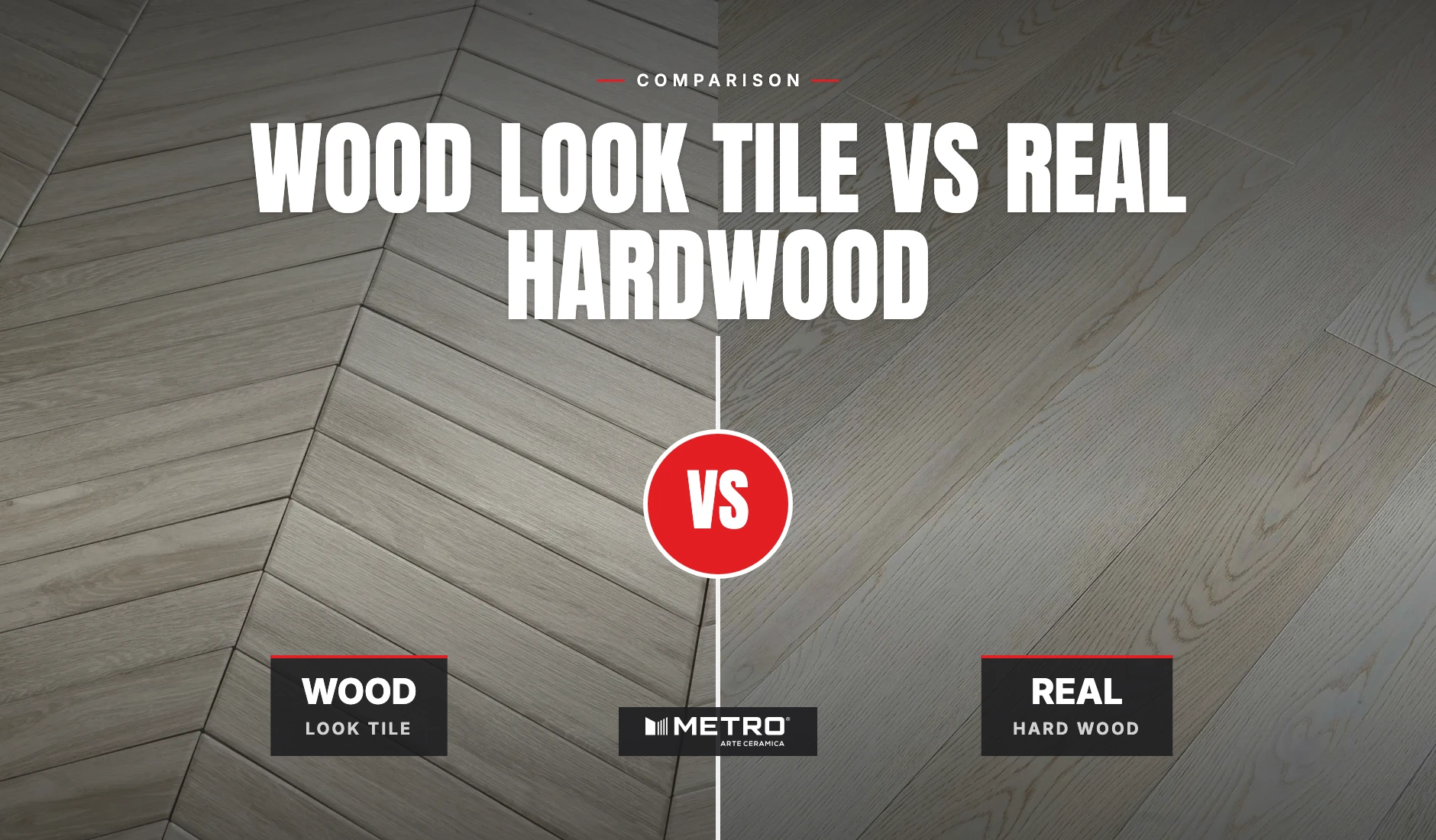
Five years ago, wood look tile was the backup plan. You chose it when the room ruled out hardwood, and you accepted that it would read as tile. That is no longer the trade you are making, and the comparison deserves a straight answer rather than a sales pitch.
This guide puts wood look ceramic tile next to solid hardwood on the things that decide the purchase. Cost, lifespan, upkeep, water, pests and resale. We make wood look tile, so read the section on where hardwood still wins with that in mind. It is there because it is true.
Wood look tile vs hardwood at a glance
|
Wood look ceramic tile |
Solid hardwood |
|
|
What it is |
Fired clay body with a printed, textured glaze |
Milled solid timber, finished on site or in factory |
|
Dimensional stability |
Does not move with room humidity |
Takes on and gives off moisture with the air around it |
|
Water resistance |
Surface unaffected by standing water |
Damaged by standing water and persistent damp |
|
Refinishing |
Not possible; the glaze is the surface |
Possible; how many times depends on wear layer and condition |
|
Routine upkeep |
Sweep and damp mop |
Sweep, damp mop, plus a refinishing cycle |
|
Termites |
Not a food source |
Vulnerable in much of the South |
|
Outdoor use |
Suitable for outdoor floors |
Not an exterior floor |
|
Underfoot comfort |
Harder, colder without radiant heat |
Warmer, slight give |
|
Repair |
Replace the affected tile |
Sand and refinish the affected area |
What each one actually is
Metro's planks are glazed ceramic. The body absorbs 6 to 8% of its weight in water, group BIIb under EN 14411, and the printed, textured glaze on top is the surface you walk on. We are specific about this because the highest-volume search phrase in this market is "wood look porcelain tile", and Metro does not make porcelain. Porcelain absorbs under 0.5%. Ceramic absorbs more through the body, and the glaze is what faces the room either way.
Solid hardwood is milled timber. The USDA Forest Products Laboratory's Wood Handbook puts the central point plainly. Wood is hygroscopic: it takes on moisture from the surrounding environment and gives it back. Shrinkage and swelling are the result. Every seasonal gap, cup and creak in a solid wood floor traces back to that one property. A fired ceramic body has no equivalent behavior. The tile you install in July is dimensionally the same tile in January.
Engineered wood sits between the two, with a veneer over a plywood core. It moves less than solid wood and can be refinished fewer times, sometimes only once.
Cost: what actually drives the number
Neither product has a single price, and anyone quoting you one figure for "hardwood" or one for "tile" is describing their own inventory rather than the market.
On the hardwood side the species and grade drive most of it. Red oak and hickory sit well below walnut. Width matters, since wide plank costs more per square foot than strip. Site-finished floors add days of labor and the cost of having the room out of use.
On the tile side the format drives material cost, and the subfloor drives labor. A floor that needs leveling before tiling can cost more to prepare than to cover. Long plank formats take longer to set than a square tile because each one has to be checked for lippage as it goes down.
Two costs get left out of most comparisons. The first is the refinishing cycle on hardwood, which is a real recurring expense across the life of the floor rather than a one-time purchase. The second is waste: order 10% over your measured area for cuts on either product, and store the overage. Buying 10% extra at the time of order is cheap insurance against a discontinued run three years later.
Ask any supplier for a delivered price for your exact format and square footage. Any supplier who won't give you a number is worth a second look.
Durability and lifespan
These two words get used interchangeably and they should not be.
Hardwood's advantage is renewability. A solid wood floor that is damaged can be sanded back and refinished, which is why hardwood floors survive in houses far older than anyone reading this. The National Wood Flooring Association is careful about how many times that can happen. The number depends on the thickness of the wear layer, the flatness and condition of the floor, the equipment and the contractor's skill. It is not a fixed number, and a floor sanded aggressively once has fewer goes left than one sanded well.
Tile's advantage is that it does not need renewing. There is no wear layer to run out, because the glaze is the surface and it is fired, not applied. Metro's planks test at a breaking strength of 280 to 300 kg/cm², about 27.5 to 29.4 N/mm².
The honest difference is in failure mode. Hardwood degrades gradually and visibly: it scratches, dents, grays at the edges, and tells you years in advance that it needs attention. Hardwood shows a dog's nails within the first year in most homes. Tile does not degrade gradually. It either sits there unchanged or a tile cracks, usually because something heavy was dropped or the subfloor moved. A cracked tile is replaced individually, which is a smaller job than refinishing a room but needs matching stock on hand.
Maintenance
This is the least even comparison in the table.
Tile maintenance is sweeping and a damp mop with a pH-neutral cleaner, for the life of the floor. There is no sanding, staining or refinishing cycle, and no annual polish. The grout is the part that needs thought rather than the tile, and a tone-matched grout in a sensible color hides normal soiling.
Hardwood needs the same sweeping and damp mopping, plus the refinishing cycle, plus care about what gets used on it. Steam mops and standing water are both problems. Rugs at entries matter more, because grit tracked in is what abrades the finish.
If the room is a kitchen, mudroom, laundry or bath, the upkeep gap gets wider still. Our guide to wood look tile in bathrooms and wet areas covers what actually holds up in those rooms.
Water resistance
Tile and grout are water resistant, not waterproof. That distinction matters. A tiled floor still needs a waterproofed substrate in a wet room, because the assembly under the tile keeps water out of the structure, not the tile itself.
With that said, the surface comparison is not close. A glazed tile face does not care about a dropped glass, a leaking dishwasher caught the next morning, or a wet dog. The same events on solid hardwood range from a stain to a board replacement depending on how long the water sat.
Metro planks can also be used on outdoor floors, in every climate including states with freezing winters, with the Matt Texture surface for grip. Real hardwood does not go outside at all.
Termites and pests
In much of the southern United States this belongs in the comparison rather than as a footnote. Subterranean and Formosan termites eat cellulose, and a solid wood floor in contact with a damp substrate is a food source. Treatment, monitoring and repair are ongoing costs in those regions.
A fired ceramic tile is not a food source. It does not change what termites may do to the framing around it, so this is not an argument that tile solves a termite problem. It removes the floor itself from the menu.
Environmental impact
Both products have a real footprint and the honest version is that neither is obviously the greener choice.
Timber is a renewable material and a carbon store, and responsibly harvested wood is a genuine argument in its favor. Against that, it carries a finishing cycle: each refinish uses abrasives and coatings, and the floor's service life depends on that maintenance continuing.
Ceramic tile is fired, and firing is energy intensive. Against that, the floor does not need refinishing, and a floor that is not replaced is the largest environmental saving available in flooring. Metro holds ISO 14001 for environmental management.
We have left figures out of this section deliberately. Numbers on water recycling, trees saved and product lifespan circulate in tile marketing, including on our own sustainability page, and we are not going to repeat them here as facts.
Resale value
Hardwood has the stronger reputation with buyers, and that reputation is itself worth something in a listing. Real estate agents in most markets will tell you hardwood in the main living areas reads as an upgrade.
Tile's position depends on the room. In a kitchen, bath, mudroom or sunroom, tile reads as the correct specification rather than a compromise. A wood look plank gets the visual warmth there without the maintenance question a buyer's inspector would raise. In a primary bedroom it is a harder sell in most of the country.
Anyone offering you a percentage figure for flooring's effect on resale is guessing. It varies by region, price bracket and the room in question.
Where real hardwood still wins
Telling you that up front costs us a sale in half the country, but these are real.
Underfoot comfort. Tile has none of the slight give hardwood has, and without radiant heat underneath it reads colder in winter. In bedrooms and quiet living rooms this outweighs the durability advantage for a lot of people. Stand on a sample before committing a main living area.
A floor you plan to renew rather than replace. Some owners stay put a long time and expect to sand the floor back twice along the way. Hardwood is the product that assumes exactly that.
An uneven existing subfloor. A floating or nail-down wood system tolerates a subfloor that tile would not. Tile is far less forgiving of deflection and unevenness, and correcting it is the hidden cost in a lot of tile quotes.
Our honest pros and cons of tile that looks like wood goes further into the trade-offs if you are weighing this room by room.
What separates a convincing plank from an obvious one
If you do go with tile, three things decide whether it reads as a board or as a tile pretending to be one.
The edge. Metro makes only curve edge, which is what the industry calls non-rectified. Each plank is pressed to size in its own mold, so the edge is softly rounded like a real board and the joint reads as the shadow line between two boards. A rectified plank is cut down from a larger pressed tile and butts up sharply, which reads as a grid.
The number of faces. Each design is printed with several random faces so neighboring planks are not identical. The count is per design, not per range, so ask for the figure on the design you are considering.
The joint. Use spacers of at least 3 mm, with 3 to 5 mm the working range. A curve edge laid tight looks wrong.
Choosing a size
150x900mm (6 x 36 in): the narrowest plank and the closest in proportion to a sawn board. The one to use where you want the floor to read as strip flooring.
200x1200mm (8 x 48 in): a wide plank for open-plan rooms, with fewer joints across the floor and the most matte options in the range.
Each plank is 9 to 9.5 mm thick, about 3/8 inch. The downloadable catalog lists every design by size, or see every design in one place.
The short version
Choose hardwood for bedrooms and quiet living spaces where warmth underfoot matters most, and where you intend to refinish rather than replace. Choose wood look tile for kitchens, baths, mudrooms, laundries, sunrooms, basements and anywhere that meets water, and for any floor you would rather not think about again.
The right answer is rarely one material for the whole house. Metro is India's No. 1 brand specialized in wooden tiles, shipping factory-direct to more than 30 countries. Tell us about the space, its size and how it gets used, and we'll help you pick the size and finish. Talk to our team about samples to test under your own lighting.
Frequently asked questions
Is wood look tile cheaper than hardwood?
It depends on the species you are comparing against and on your subfloor. Tile usually costs less than walnut or wide-plank white oak and can cost more than builder-grade red oak once leveling is included. Get a delivered price for your exact square footage rather than working from an average.
Does wood look tile increase home value?
In kitchens, bathrooms, mudrooms and basements it reads as the right specification and is unlikely to count against you. In bedrooms and main living rooms, hardwood still carries the stronger reputation with buyers in most US markets.
How long does wood look tile last compared to hardwood?
They fail differently rather than one simply outlasting the other. Hardwood can be sanded and refinished, so a maintained floor survives a long time; tile does not need renewing at all, but a cracked tile is replaced rather than repaired. Keep spare tiles from your original run.
Can you put wood look tile over an existing floor?
Sometimes, depending on the existing floor and the total height you can add at doorways and cabinets. The subfloor has to be sound and flat, and flatness is the usual reason a tile job needs prep work first.
Is ceramic or porcelain better for a wood look floor?
Porcelain absorbs under 0.5% through the body; glazed ceramic like Metro's absorbs 6 to 8%, with the glaze facing the room. For interior floors and for outdoor floors with a matte surface, the glazed ceramic plank performs. Ask any supplier which one they actually make, because the terms get used loosely.
Do wood look tiles feel cold?
Without radiant heat underneath, yes, noticeably so in winter in northern states. Tile works well over underfloor heating, which is the usual answer if you want the tile in a room where this matters.
Can wood look tile be used outdoors?
Yes. Every Metro design can be used on outdoor floors, including open patios in states with freezing winters, using a Matt Texture surface for grip. Hardwood is not an exterior floor.