

17 October 2026 7 min read
Wood look tile in the kitchen: durability, spills and standing
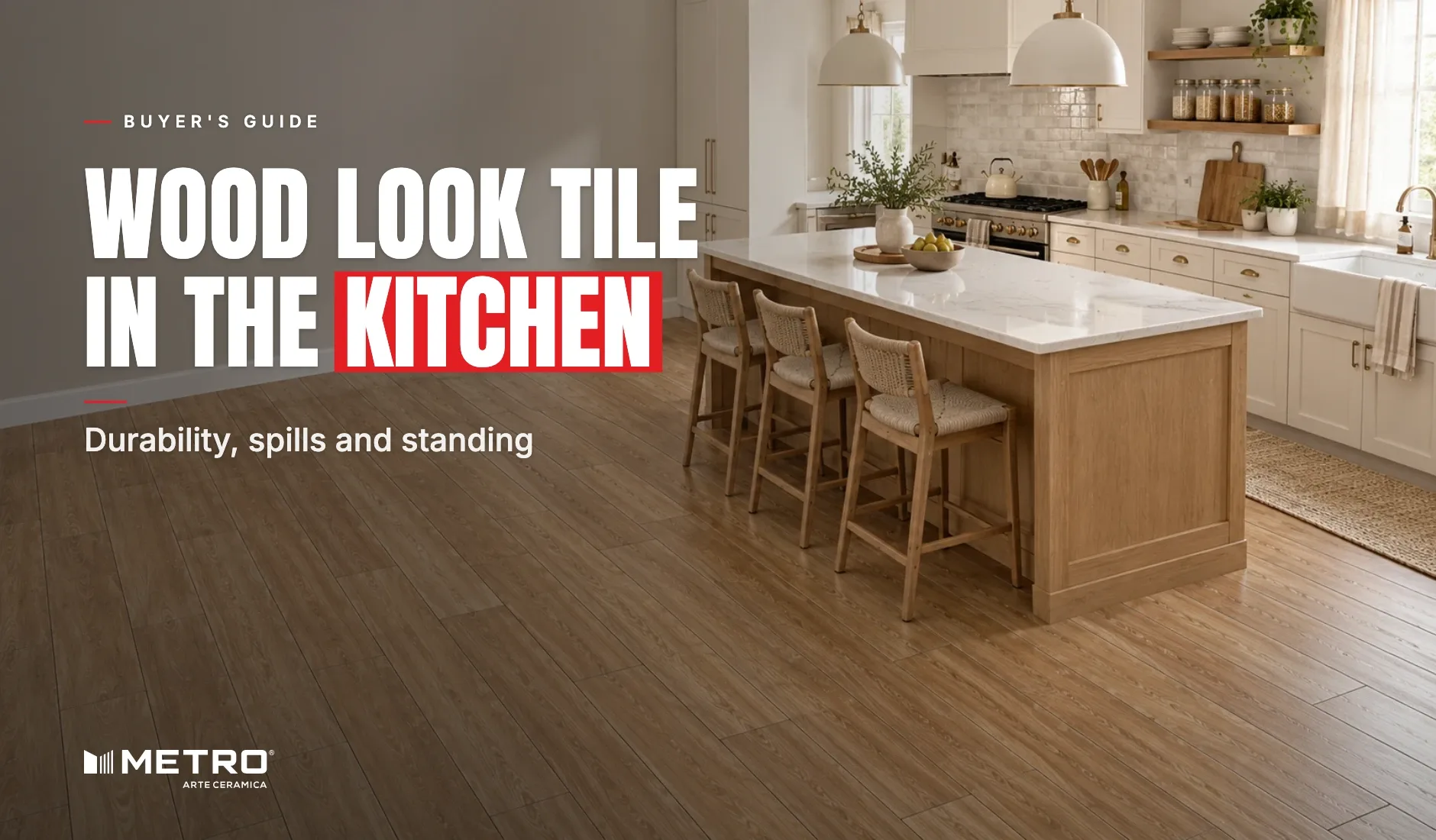
In an open-plan house the kitchen floor is not really a kitchen floor. It runs into the dining area and often all the way to the living room, so it has to survive a dishwasher leak and still look right under a sofa.
Wood look tile is the usual answer, and in a kitchen it is a better answer than in most rooms. There are two decisions that matter and one trade-off that nobody mentions in a showroom.
What a kitchen floor actually faces
Water events, not just spills. A dishwasher or ice maker that lets go puts gallons on the floor, not a cup. Hardwood in that situation is a replacement, not a cleanup.
Grease, slowly. A thin film of cooking oil reaches most of the floor over a few months. On a smooth floor that is a slip problem long before it is a cleaning problem.
Point impacts. A cast iron skillet landing on a corner is the one thing that chips any glazed tile, and it is worth knowing before you choose rather than after.
Constant cleaning. A kitchen floor gets mopped more than any other floor in the house, often with something stronger than it needs.
Decision one: the surface
Pick Matt Texture. It is the matte, low sheen surface with grain relief you can feel underfoot, and that relief is what gives grip when there is water or a grease film on the floor. 71 designs carry it, 41 of them in 200x1200mm.
Satin Plain is smooth with no relief. In a kitchen that is the wrong pick for exactly the reason above. Keep it for dry rooms and walls, and keep Satin Texture for living rooms and bedrooms.
Decision two: the grout
The glaze does not stain. Grout can, and in a kitchen it will.
Use a mid or dark grout in a tone near the plank color. Pale grout in a kitchen reads as a grid of discolored lines inside a year, and because the curve edge already gives you a shadow line between planks, matching the grout costs you nothing visually.
Ask for a grout rated for wet areas and have your installer clean the haze off the same day. Grout haze left to dry is the most common complaint on a brand new floor, and it is not a tile defect.
Why tile beats hardwood here specifically
Water is a non-event. The tile you install in July is dimensionally the same tile in January, and a leak is a mop rather than a claim.
It is glazed ceramic, absorbing 6 to 8%, which is group BIIb under EN 14411. Porcelain is defined in the US as 0.5% absorption or less, measured by ASTM C373, which the Tile Council of North America explains here. That difference describes the body under the glaze. In a kitchen, grease, water and tomato acid meet the glaze, and the glaze wipes.
No refinishing schedule. Hardwood in a kitchen is the room that forces the refinish early. Tile has no equivalent.
The grain is printed in 3D high definition with real relief, and each design has its own number of randomized faces, from 1 to 18 across the plank range. Ask for the count on the specific design before you order a large open floor.
The trade-off nobody mentions
Tile is hard, and a kitchen is where you stand still for an hour.
If you cook seriously, you will feel a tile floor in your feet and knees in a way you will not feel engineered wood. An anti-fatigue mat at the sink and the range solves it for about thirty dollars, and most people do that anyway. But telling you up front costs us a sale now and then, and it is better than you finding out at Thanksgiving.
Tile is also colder underfoot. Over radiant heat that disappears, and tile conducts heat better than wood does, so the kitchen is often the best room in the house for it. Our guide to wood look tile over underfloor heating covers the detail.
Choosing a size
- 150x900mm (6 x 36 in): the narrowest plank, closest to a sawn board, and the one that cuts most cleanly in a galley kitchen. 8 tiles per box, 11.62 sq ft, 48.5 lb.
- 200x1200mm (8 x 48 in): the widest choice of matte designs, and fewer joints across an open-plan floor. 5 tiles per box, 12.91 sq ft, 55 lb.
- 200x1400mm (8 x 56 in): the longest plank, for a kitchen that runs into a large living area. 4 tiles per box, 12.05 sq ft, 53 lb.
A long plank reads well across an open floor and works against you in a galley, where most planks get cut at the cabinets. Each size page has a coverage calculator, and full specs are in the downloadable catalogs.
Installation notes
- Flatten the subfloor first. Long planks show a dip. The usual tolerance an installer works to is 1/8 inch over 10 feet.
- Use a thinset rated for the job. ANSI A118.4 modified thinset is the normal call for plank tile.
- Joints of 3 to 5 mm, with spacers of at least 3 mm. The formed curve edge needs that width.
- Offset each row by a quarter plank: 225 mm on 150x900mm, 300 mm on 200x1200mm, 350 mm on 200x1400mm. Our laying catalog rules out the 50:50 half offset.
- Keep the back arrows one way, and lay one room from a single calibre code.
- Order 10% extra and store it. A chipped plank in year four is then a swap, not a search.
The short version
Matte surface, grout close to the plank color, and a mat where you stand. Those three decisions do more for a kitchen floor than the color does, and the first two cost nothing to get right. If you are still comparing materials, our wood look tile against real hardwood comparison covers cost and maintenance.
Tell us about the space, its size and how it gets used, and we'll help you pick the size and finish. Talk to our team.
Frequently asked questions
Is wood look tile good for a kitchen floor?
Yes, and the kitchen is one of the rooms where it clearly beats hardwood. Water, grease and heavy cleaning are routine in a kitchen, and a glazed ceramic floor handles all three. Use the matte surface for grip.
Which surface should I use in a kitchen?
Matt Texture, the matte surface with grain relief. A smooth surface such as Satin Plain has nothing to grip against once a grease film builds up, so it belongs in dry rooms.
Does wood look tile stain from food or oil?
The glaze does not stain. The grout can, so use a mid or dark grout tone and clean spills the same day. That one choice does more for how the floor ages than the tile color.
Will a dropped pan crack the tile?
A cast iron pan landing on a corner can chip any glazed tile. The fix is to replace that one plank, which is why you keep 10% spare from the same batch and calibre.
Is tile too hard to stand on while cooking?
It is harder than wood, and if you cook for long stretches you will notice. An anti-fatigue mat at the range and the sink solves it, and most cooks use one regardless of flooring.
What size plank suits a galley kitchen?
150x900mm (6 x 36 in). A long plank in a narrow kitchen means most pieces get cut along the cabinet run, which wastes material and looks busier.